
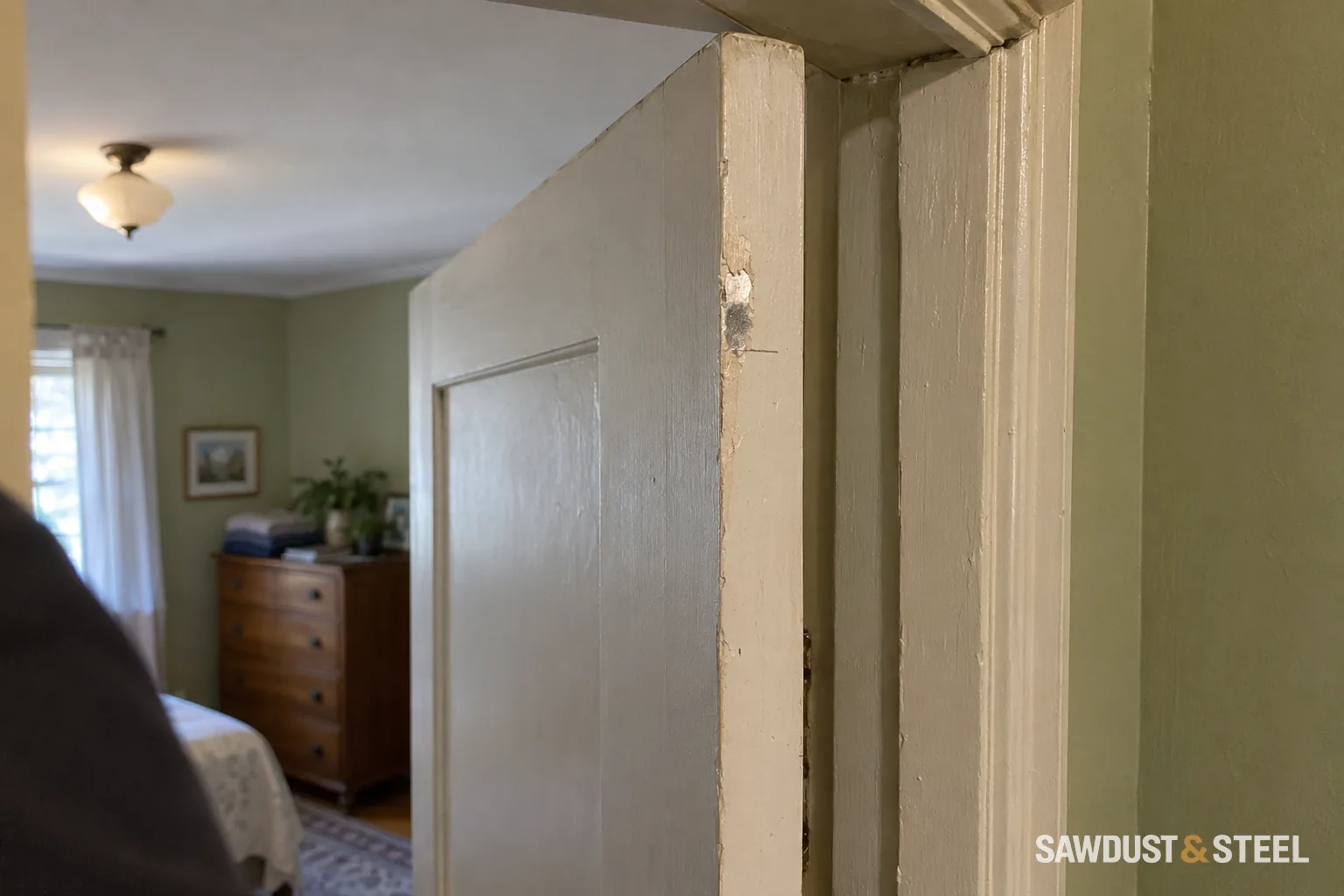
The door needs a shoulder in August and closes politely in February. Removing a little wood feels obvious until you remember that February will return.
Look at the whole opening
Record the rubbing point, hinge condition, gaps, and whether nearby doors behave similarly. The US Forest Service Wood Handbook explains how moisture changes wood dimensions. That makes humidity a plausible contributor, not proof that every sticking door is harmless.
Match the symptom to the next check
| What you notice | Useful next check |
|---|---|
| A visible rub at the edge that comes and goes with the season | Record the rub location and room humidity over time before removing wood. |
| A hinge moves at its fixing, or a screw will not hold | Investigate stripped hinge-screw holes before treating the edge as oversized. |
| The door releases with a sticky pull after painting, at the stop | Compare paint sticking to the door stop with a timber clearance problem. |
| The bottom rubs after new flooring | Check the new floor height and the door construction; the hollow-core trimming guide explains why trimming allowance matters. |
Take one photo of the whole opening and one of the contact point. These observations choose the next investigation; they do not prove that seasonal swelling is the only cause. Keep new cracking, widespread misalignment or a sudden change in the structural assessment below.
| Pattern | Check first | Avoid |
|---|---|---|
| Top latch corner rubs and latch edge drops | Loose hinges or fixing movement | Planing before restoring hinge support |
| Most of a wooden edge tightens in humid weather | Record room humidity and repeat gap photos | Removing a large amount while wood is swollen |
| Opening diagonals or wall cracks change | Frame/building movement assessment | Treating every change as seasonal wood swelling |
| Only the latch catches | Strike alignment and door closing position | Cutting the slab to fix a hardware problem |
For a week, record date, room humidity, rub location and whether the latch works without lifting the handle. Use the same hygrometer position away from the bathroom plume or open window. The Wood Handbook explains moisture-related dimensional change; your diary helps separate a seasonal pattern from a sudden failure. Check strike alignment when the door closes freely but will not latch.
Keep the remedy proportional to the evidence
A carpenter can assess alignment and permissible trimming for the particular door. Do not trim a fire-rated or specialist door casually; its construction and requirements matter. If the binding is new and accompanies cracking, sagging, water damage, or several distorted openings, investigate the underlying condition instead of repeatedly shaving the symptom.
Before the next step
- Photograph the gaps and exact rubbing point.
- Compare the symptom across seasons and nearby openings.
- Confirm door type and allowable alterations before cutting.
Start with the rubbing point and the hinges, and tell the carpenter whether the door behaved this way last summer. That small bit of history can save wood you may want back in February.