
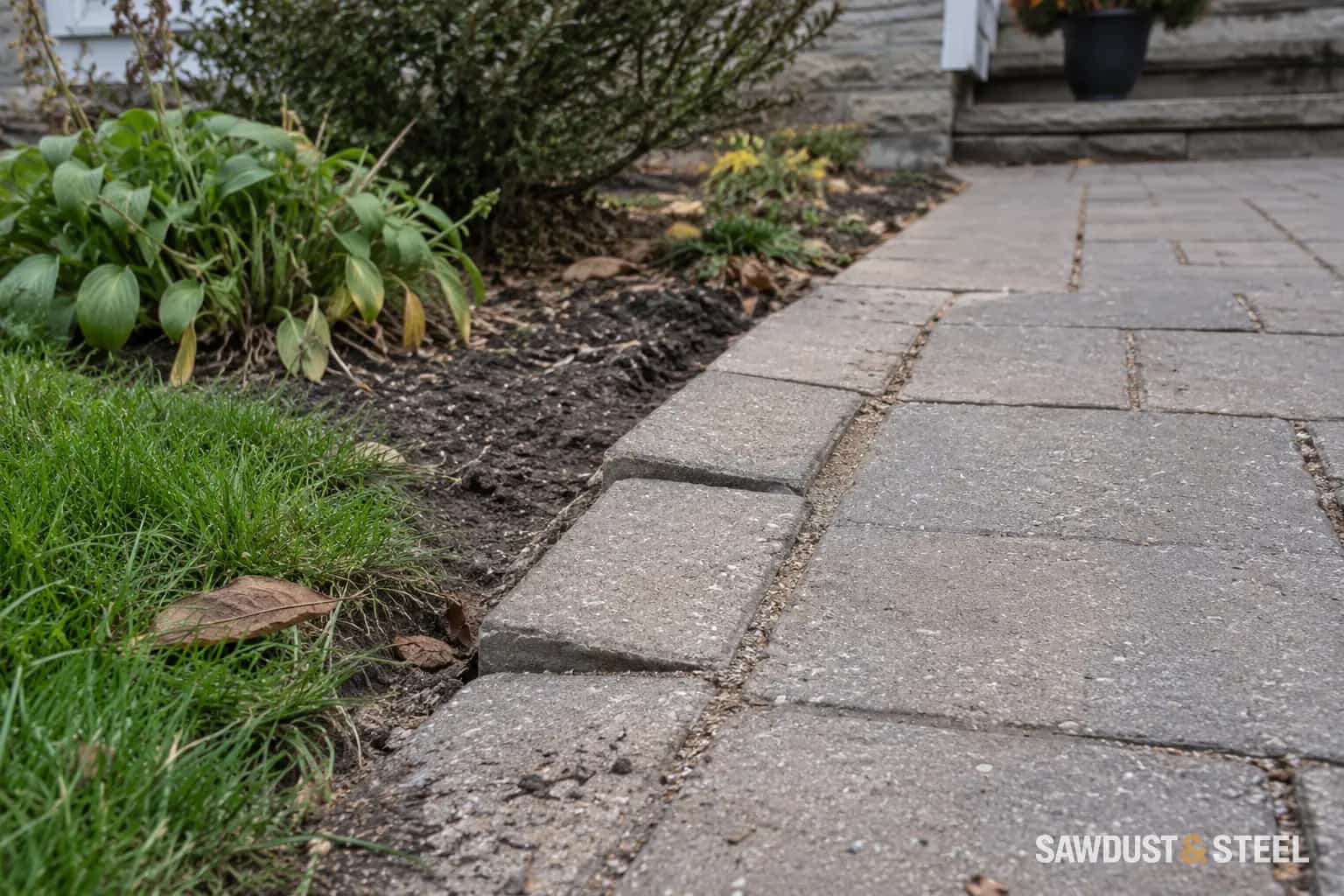
Follow the washout pattern uphill
A narrow channel beneath a downspout suggests concentrated water. Broad loss at an open edge suggests a containment issue; scattered empty joints after cleaning may follow an aggressive pressure-washing pass. Photograph the surface during rain from a safe, sheltered location. Look beyond the patio itself for roof discharge, sloping beds and runoff arriving from another paved area.
Below a discharge
Investigate concentrated runoff.
Along the perimeter
Check edge restraint and unit movement.
Across recently washed paving
Review cleaning method and joint loss.
Identify what is in the joints
Plain sand, polymeric sand and permeable-joint aggregate are not interchangeable. Find the installation record or have a hardscape installer identify the system. Record the joint width, remaining material and whether units rock under normal walking. New binder on top of a shallow dusty joint may make a thin crust while leaving the underlying defect intact. Do not add polymeric sand to a permeable pavement unless its system explicitly calls for it.
If the loss coincides with widening outer joints, investigate The Pavers at the Edge Are Spreading Apart before adding more sand.
Refill only after the cause is addressed
Redirect concentrated flow through a suitable drainage arrangement without transferring the problem to the house or neighbour. Stabilize moving units and edges first. Use the joint-product instructions for removal depth, dry conditions, compaction, activation and curing. Protect nearby surfaces and keep traffic off for the specified interval. Revisit the repaired area after rain: joint material that stays in place is better evidence than its appearance just after sweeping.
Unilock directs owners to compatible sands and cleaning products; the selected product instructions must govern application rather than a generic water-and-sweep method. Unilock: paver care questions.
Before you finish
- Identify conventional versus permeable paving.
- Fix runoff and movement before refilling.
- Check the repair after the next rain.