
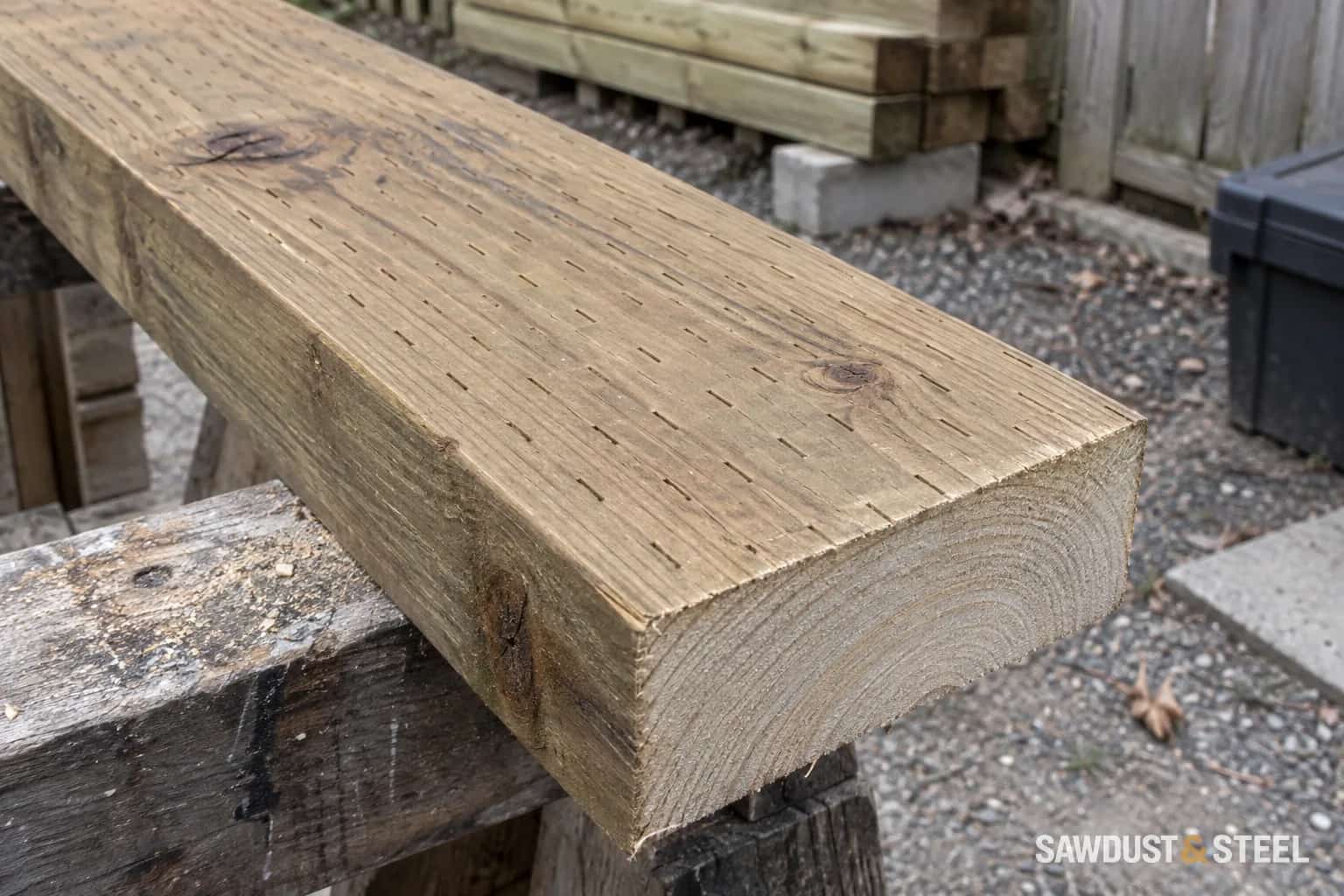
When the joists arrived for a deck in Ajax, Daniel sent us a close-up before the delivery truck had left. The faces had neat little slits in repeating rows. His message was brief: should these go back? We checked the end tag and the manufacturer's information. The marks were part of preparing that lumber for treatment, not something the delivery had done to it.
The cuts happen before the preservative goes in
Incising means piercing the surface with small slits so preservative can penetrate more consistently. MicroPro Sienna describes this process for its structural joists, beams and posts. Its incisions are made before pressure treatment. They are not ventilation holes and they are not a request to fill each mark before building the deck.
- At the factory, the lumber is incised where the product's treatment process requires it.
- The wood is pressure treated, with the incisions helping preservative penetration.
- At the job, a saw cut, notch or drilled hole may expose wood beyond the original treated zone.
- Those new field cuts follow the lumber supplier's treatment instructions for the intended exposure.
That sequence explains why factory marks and new holes do not get the same answer. Our fresh-cut treatment guide covers the work after the board reaches the site, including Sienna's different directions for above-ground and ground-contact uses.
What does the pattern tell you?
| What you see | What to check |
|---|---|
| Repeated small slits across the lumber face | Compare them with the named manufacturer's incising information and the product label. |
| A new round hole or bright saw-cut face | Identify the site work and the required field treatment before the surface is concealed. |
| Irregular holes, crushed areas, soft wood or a significant split | Have the condition assessed separately. Factory incising does not explain every mark or establish that a member is sound. |
| Smooth treated lumber with no obvious slits | Check the species, product and intended use. Missing visible incisions alone do not prove missing treatment. |
Why does some treated lumber look smooth?
Wood species do not all accept preservative equally. The Western Wood Preservers Institute's incising explanation describes harder-to-treat Douglas-fir and Hem-Fir and contrasts them with Southern Yellow Pine, whose cells accept preservative more readily. That is a species and treatment distinction, not a reason to reject every smooth board in a Canadian lumber yard.
Keep manufacturer claims with the products they describe. Sienna's structural-lumber instructions are useful for Sienna; another product needs its own information. Neither the brown colour nor the presence of slits tells you the complete treatment specification.
Read the tag before deciding where the wood belongs
Sienna's working instructions identify the end tag as the place to check appropriate usage. Above-ground and ground-contact applications are different exposures. A board being a few centimetres clear of soil does not settle every moisture condition; the product instructions also address low decks, restricted air circulation and other demanding uses.
Daniel kept one labelled offcut with the deck paperwork. It was easier than remembering which of the nearly identical brown boards had been ordered for which job. The repeating slits stayed as they were. The fresh cuts made during fitting got their separate treatment check.
Choosing the appearance of the finished surface? Use the actual product's preparation instructions and our new-deck staining guide. Looking at an older deck with unexplained deterioration? Start with the ground-level deck safety check, rather than assuming all its marks came from the factory.