
You close the gate, the road disappears, and the trucks still sound remarkably present. That is not necessarily a defective fence. Blocking a view and reducing outdoor sound are related tasks, but they are not the same result.
Start by identifying the noise you want to change. Is it continuous traffic, individual trucks, an elevated road, a neighbour's equipment or voices from the adjoining patio? Note where you sit and when the disturbance is worst. A barrier suitable for a ground-level source may do little for sound arriving from above.
Look at the source, the barrier and your chair
The US Federal Highway Administration's acoustical guidance explains that barriers affect the paths sound can take, including travel over the top and around the ends. Those physical principles are useful for a yard, but highway barrier performance should not be copied as a promise for a domestic fence.
| Claim | Ask for |
|---|---|
| Noise reduction | Test conditions and receiver position |
| Panel rating | What frequency range and assembly were tested |
| Installation | Treatment of gates, joints and ends |
| Structure | Support design for the complete surface |
Draw a simple section from the road to the fence to the seating area. Include changes in ground level. Then draw a plan showing the ends of the fence and nearby openings. If the road is clearly visible above or around the proposed barrier from the chair, those paths need attention before arguing about board thickness.
Try moving the seating area before commissioning major construction. A chair behind an existing solid part of the house may be more comfortable than one beside an open side passage. Visit both positions during the same busy period. This comparison costs nothing and can reveal whether the proposed fence is in the useful place.
A privacy product is not automatically an acoustic assembly
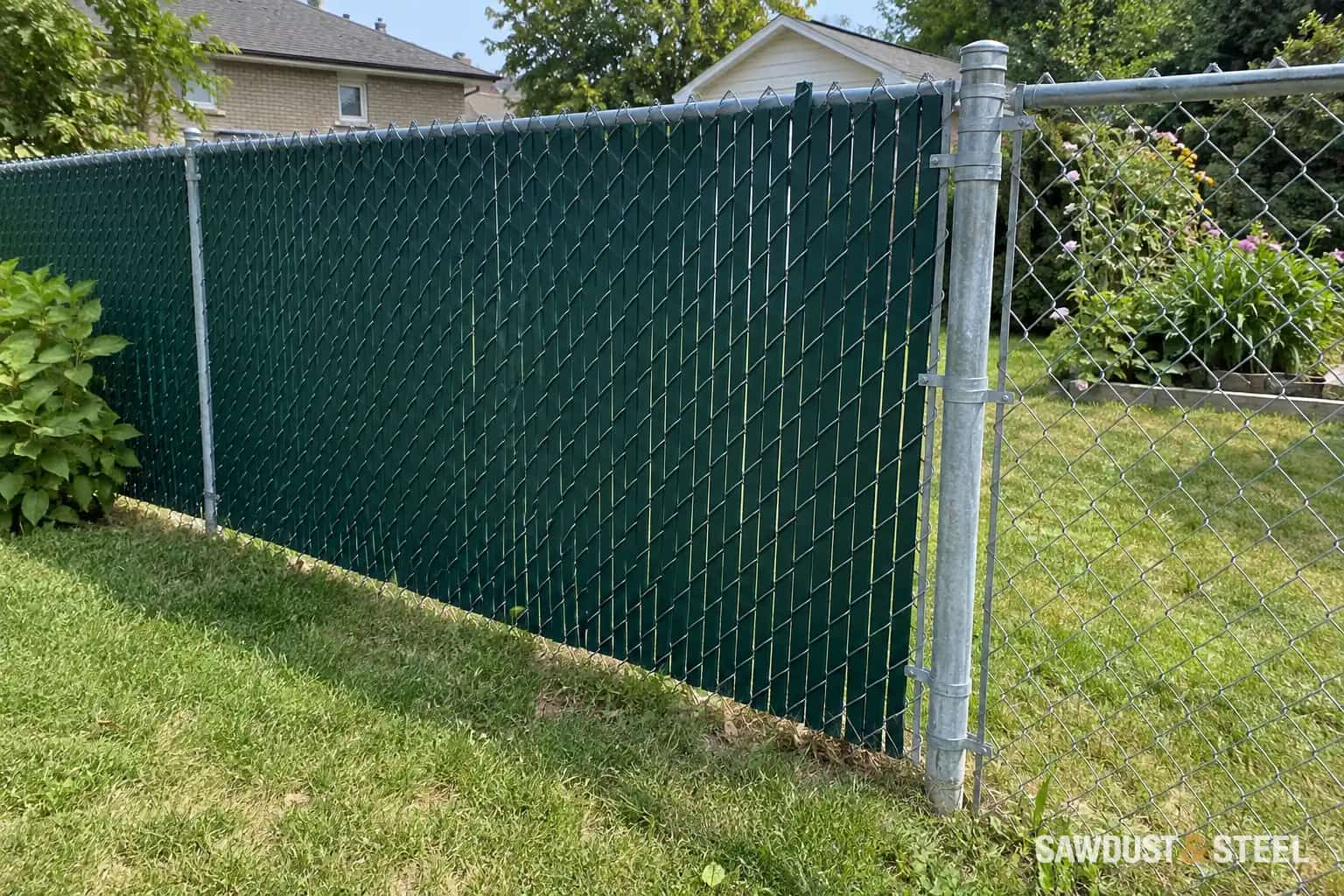
Open slats, decorative gaps and chain-link privacy inserts can screen views while leaving many paths for sound. Conversely, a continuous assembly must still deal with gates, joints and the edges of the site. A small sample panel does not show what happens at those interruptions.
The same FHWA reference cautions that sound-transmission ratings designed around speech frequencies do not directly describe traffic noise. Ask a supplier what its published result actually measures: a laboratory panel, a complete barrier or an installed situation. Ask what assumptions apply to height, length, gaps and the position of the listener. A useful answer includes those conditions rather than one impressive number.
Work within the yard you have
A taller and more continuous fence can also collect more wind load. Adding boards or acoustic lining to an existing light fence changes what its posts and foundations must resist. The issue is similar to adding privacy slats to chain-link: the new surface needs structural consideration, even if the old fence stood for years.
Do not block required sightlines, access or drainage to create a continuous barrier. Toronto's fence guidance sets local restrictions on height, location and materials. Other municipalities have their own rules. Establish the permitted envelope before paying for a design that only works if the fence is much taller than allowed.
Planting can improve the feel of a space, screen views and soften reflected light. Ordinary garden shrubs should not be sold as a replacement for a designed sound barrier. Likewise, a fountain may make a patio more pleasant by adding a preferred sound, but it does not remove the traffic reaching the yard.
Ask for a result you can evaluate
For a substantial investment, an acoustic professional can assess the actual sources and layout. Describe the aim in ordinary terms: easier conversation at the dining table, less disturbance at the bedroom window, or a more comfortable corner for reading. Those are different receiver positions and may need different solutions.
Compare the proposed fence with relocation of seating, a smaller sheltered area or other changes to the outdoor layout. Keep boundary-fence agreements separate from performance claims. Your neighbour agreeing to a fence does not prove that it will deliver the promised reduction, and a quiet-looking rendering cannot answer that question.