
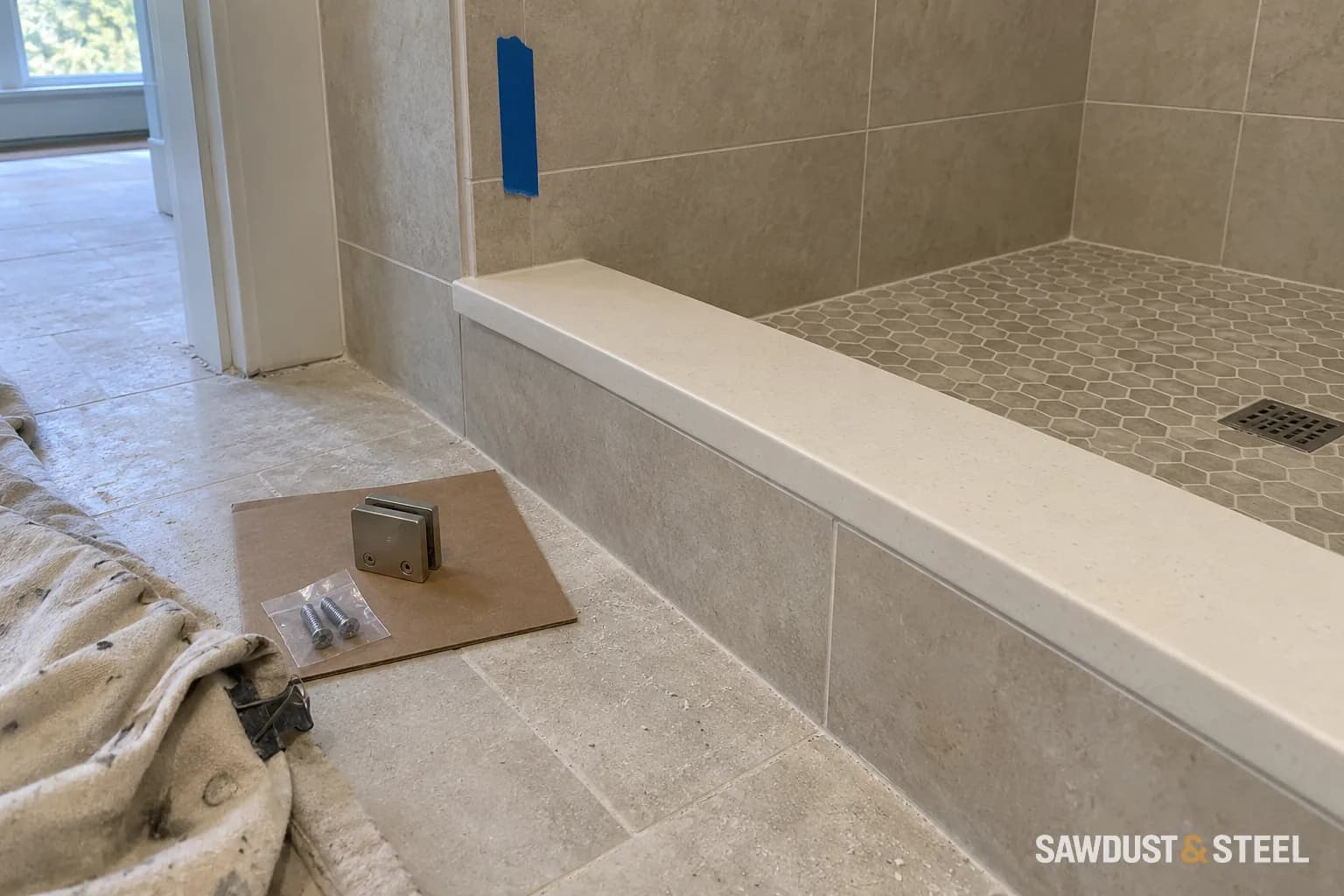
The shower has passed its water test. The glass installer arrives with a drill. Both events can belong in a good installation, but the detail between them needs to have been discussed.
Choose the fixing arrangement early
Identify where the glass will be supported and which brackets or channels it uses. Ask whether any proposed fastener penetrates a horizontal waterproofed surface, and have the system providers resolve that detail before tile is installed.
Do not assume a bead of sealant around every screw is a universal solution. Schluter's puncture-repair guidance distinguishes repair conditions and methods. It does not authorize every bracket arrangement in every location.
Coordinate support beneath the finish
Tile is the visible finish, not the whole fastening substrate. Provide the glass dimensions and hardware requirements to the renovation team while backing and framing can still be adjusted.
Make the handoff explicit
- Confirm the hardware and support requirements before tiling.
- Record the agreed fixing and waterproofing details.
- Mark concealed backing locations accurately for the glass installer.
- Resolve any later change before a new hole is drilled.
Ask who takes responsibility for coordinating the interface. Two installers can each know their own product well and still need a shared detail at the connection.
Use the same open-wall planning stage to consider backing for future grab bars, with its own support and waterproofing requirements.
A curb screw and a wall hinge are different details
| Location | What must be resolved |
|---|---|
| Horizontal curb or threshold | Waterproof layer depth, water exposure and an approved fastening or nonpenetrating arrangement. |
| Vertical wall hinge | Adequate backing, exact hole positions and the specified penetration seal. |
| Fixed-panel channel | Glass thickness, channel support, setting blocks and the complete enclosure design. |
| Top support or header | Loads, wall attachments and any conflict with ceiling finishes. |
A wall hinge may need structural backing because it carries a moving door. The waterproofing still needs its approved penetration treatment. A curb screw creates a different exposure: water repeatedly crosses the horizontal surface, and the waterproof layer may sit just beneath the tile. Neither location should be judged solely by whether a screw can be tightened. A solid-feeling fixing can still have an unresolved water path.
One channel option to discuss before tiling
Schluter DECO-SG is a tile-integrated support channel for glass panels. Its 12.5 mm channel accepts glass up to 10 mm thick; the 15 mm version accommodates up to 12.5 mm glass. This offers a detail to coordinate while tile is being installed. It is not a substitute for the glass designer determining the panel's complete support, nor approval to hang a moving door from an unsuitable fixed panel.
Ask the glass installer and waterproofing installer to identify the same detail on one drawing. If a chosen door requires a curb fixing that conflicts with the waterproofing system, change the hardware or resolve an approved design before measuring the glass. A verbal promise to fill the hole with silicone is not enough information to assess the assembly. Sealant identity, substrate compatibility and the location of the waterproof layer all matter.
If an unwanted hole already exists, photograph it and stop before covering it with the bracket. The repair may require exposing enough membrane to make the manufacturer's specified connection. Do not treat a dot of sealant on tile as evidence of a repaired concealed membrane. Retain the water-test record, and coordinate blocking for bathroom fixtures while the wall is open so later installers are not left guessing. Treat the glass as part of the shower design from the start. It should not arrive as an independent accessory with permission to make whatever holes it needs.