
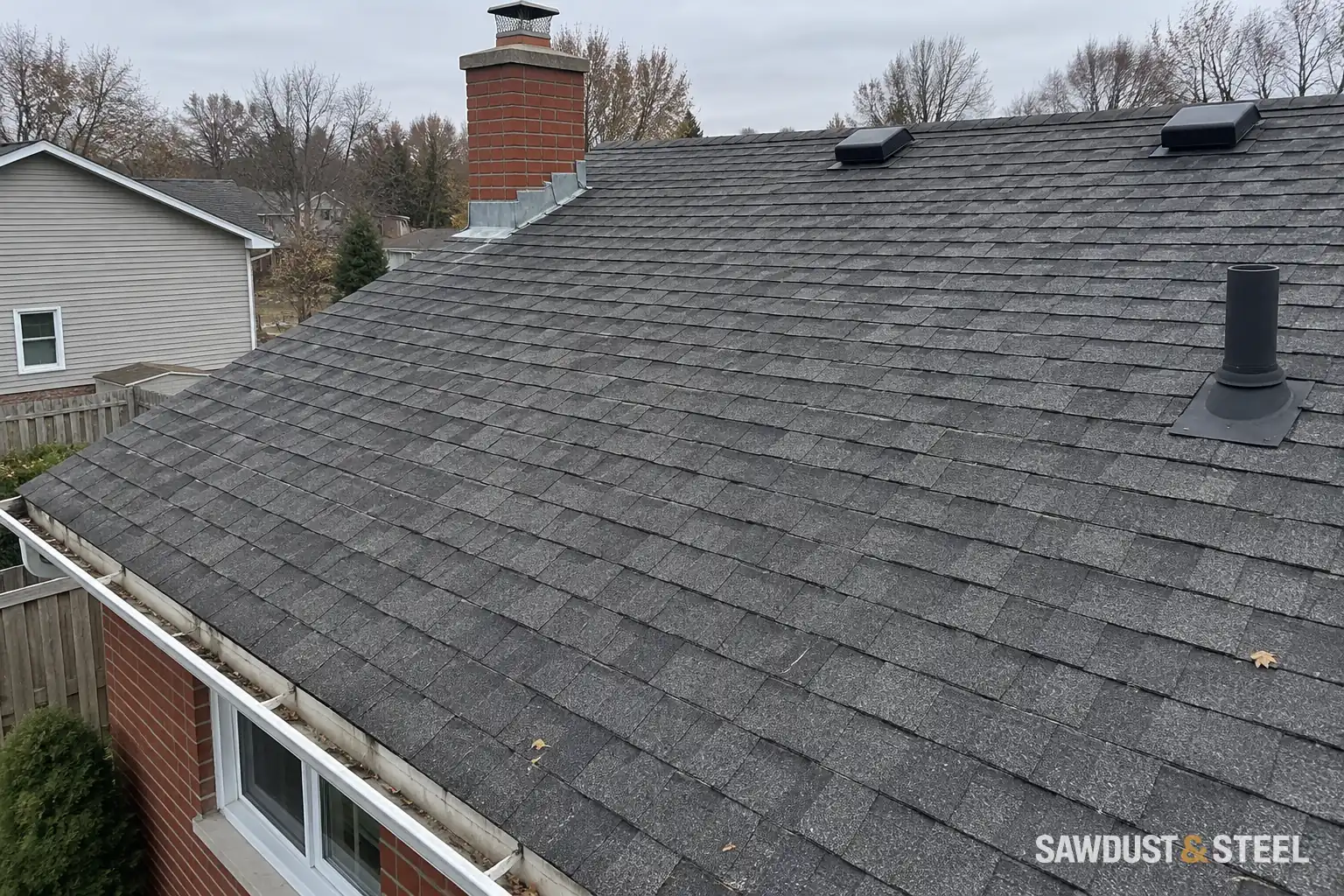
Once you notice a lifted shingle, you start seeing the whole roof differently. Is that patch bare? Has the ridge always looked like that? A new ceiling mark or changed roofline deserves attention, but one symptom does not decide the whole repair. Use the checklist below to separate what needs a closer look from what needs a prompt call.
Which roof symptoms need prompt attention?
| What you notice | What it may mean | Useful next step |
|---|---|---|
| Active water or a growing ceiling stain | Roof, flashing, plumbing, or condensation problem | Protect the area safely and arrange prompt source tracing |
| Visible sagging or a changed roof line | Deck, framing, support, or long-term moisture issue | Keep off the roof and request structural assessment promptly |
| Missing, lifted, cracked, or creased shingles | Localized damage, ageing, fastening, or storm effect | Document the affected slopes and inspect the surrounding field |
| Rusted, loose, or open flashing | A vulnerable joint at a wall, chimney, valley, or penetration | Inspect the detail and adjacent deck before simply adding caulk |
| Attic frost, dampness, stains, or mould | Roof leak, indoor air leakage, duct problem, or ventilation issue | Identify the moisture source before choosing a roof repair |
| Granules or bald patches | Normal early shedding, ageing, abrasion, or storm damage | Compare pattern, amount, roof condition, and recent weather |
| Dark roof streaks | Often algae staining; sometimes mixed with granule loss | Check condition separately; colour alone does not decide replacement |
What cannot wait for a convenient winter date?
| Observation | Immediate homeowner action | Assessment question |
|---|---|---|
| Active leak or ceiling swelling | Keep people clear of the affected area; avoid wet electrical equipment | What safe protection is needed now? |
| Loose material that may fall | Keep the area below clear and arrange prompt attention | Can access and stabilization be done safely? |
| New stain with no current dripping | Photograph and record when it appeared; arrange assessment | Roof entry, condensation or another source? |
| Older roof without a new symptom | Arrange condition review before committing to major work | What evidence supports repair or replacement? |
If water is affecting electrical equipment or an occupied area is unsafe, treat that hazard first and seek appropriate emergency help. Do not climb onto a wet, icy or windy roof to find a leak. A bucket in a safe location may protect belongings, but it does not establish that the ceiling or electrical system is safe.
What can you check safely from the ground?
Walk the property after the weather has settled. From the ground, look for changed roof lines, missing material, lifted edges, damaged vents, loose flashing, debris, and gutter sections pulling away. Binoculars or a zoom lens are useful. Take one wide shot before zooming in so the roofer knows which slope you mean. A close-up of a lifted tab with nothing around it can be surprisingly hard to locate on a large roof. If you have an older photo from the same spot, send both; a change is often more informative than one alarming angle.
Check downspout outlets and safely accessible gutter debris for unusual granule accumulation, but read it in context. New asphalt shingles can shed loose granules, while a concentrated patch after hail or widespread bald areas deserves inspection. GAF's own roof warning-sign guide describes missing, cracked, curling, stained, and leaking conditions as possible signs with possible causes, not one-step replacement orders.
What can the attic tell you?
From a safe attic platform or hatch, look for new stains, damp insulation, wet or dark sheathing, frost, rusted fasteners, mould, and disconnected exhaust ducts. Do not step between framing members, disturb suspect insulation, or touch wet electrical equipment. If access is unsafe, stop at the hatch and bring in somebody equipped for it.
Attic moisture is not automatically a failed roof covering. Natural Resources Canada explains that moisture can enter through roof or flashing defects, or arrive from indoor air leakage and poorly terminated ducts. Frost during a cold snap, for example, can point toward warm moist house air rather than rain. Find the source before buying the cure.
Does roof age decide whether it needs replacement?
Age helps set expectations, but it does not inspect the roof. Product, installation, slope, sun exposure, ventilation, maintenance, storm history, and repairs all affect condition. Manufacturer warranty length is also not a promised service life; coverage has terms, exclusions, and often changing remedies over time. Use age to decide when to look more closely, alongside its observed condition.
When can a localized roof repair be enough?
A local repair can be reasonable when the cause and damage are confined, the surrounding field remains flexible and serviceable, the deck is sound, and compatible material is available. A repair becomes harder to justify when damage is widespread, several details are failing, or the deck and underlayment have broader problems. GAF's guidance on storm-damaged shingles specifically notes that replacing individual shingles or one damaged plane may sometimes be possible.
Plan temporary protection and the permanent repair separately
A late-season inspection can lead to a small permanent repair, a larger project or temporary protection until safe conditions allow the full work. Ask the roofer to identify which result is proposed and why. Temporary work needs an agreed follow-up; a tarp is not a completed roof system.
Record how the temporary detail manages water, how its condition will be checked and what weather or material conditions the permanent repair needs. Do not cover wet or damaged material and call the underlying problem solved. Do not block a designed ventilation route as an improvised leak treatment.
Use the same condition evidence for a winter decision as for a summer decision. A serviceable roof with one failed detail does not become a whole-roof replacement solely because snow is approaching. Conversely, recurring leaks across several failing details should not be dismissed as another quick patch.
See winter roofing conditions and scheduling for the seasonal work questions. If the damage is broad, use the complete quote checklist to compare a permanent solution.
Ask for a repair quote you can follow
The quote should locate the defect, identify the proposed repair materials and affected area, distinguish temporary from permanent work, explain exclusions and state who returns for follow-up. Ask what remains uncertain until opening and how concealed damage will be approved. Keep the before and after photographs together so a later stain can be compared with the actual repaired location.
What should a professional roof inspection answer?
Ask for four plain answers: what caused the symptom, how far the damage extends, whether the deck or attic is involved, and whether repair or replacement is the proportionate response. The report should use labelled photos and separate observed facts from areas that still need opening or testing. Our storm-damage inspection guide explains where drone documentation helps.