
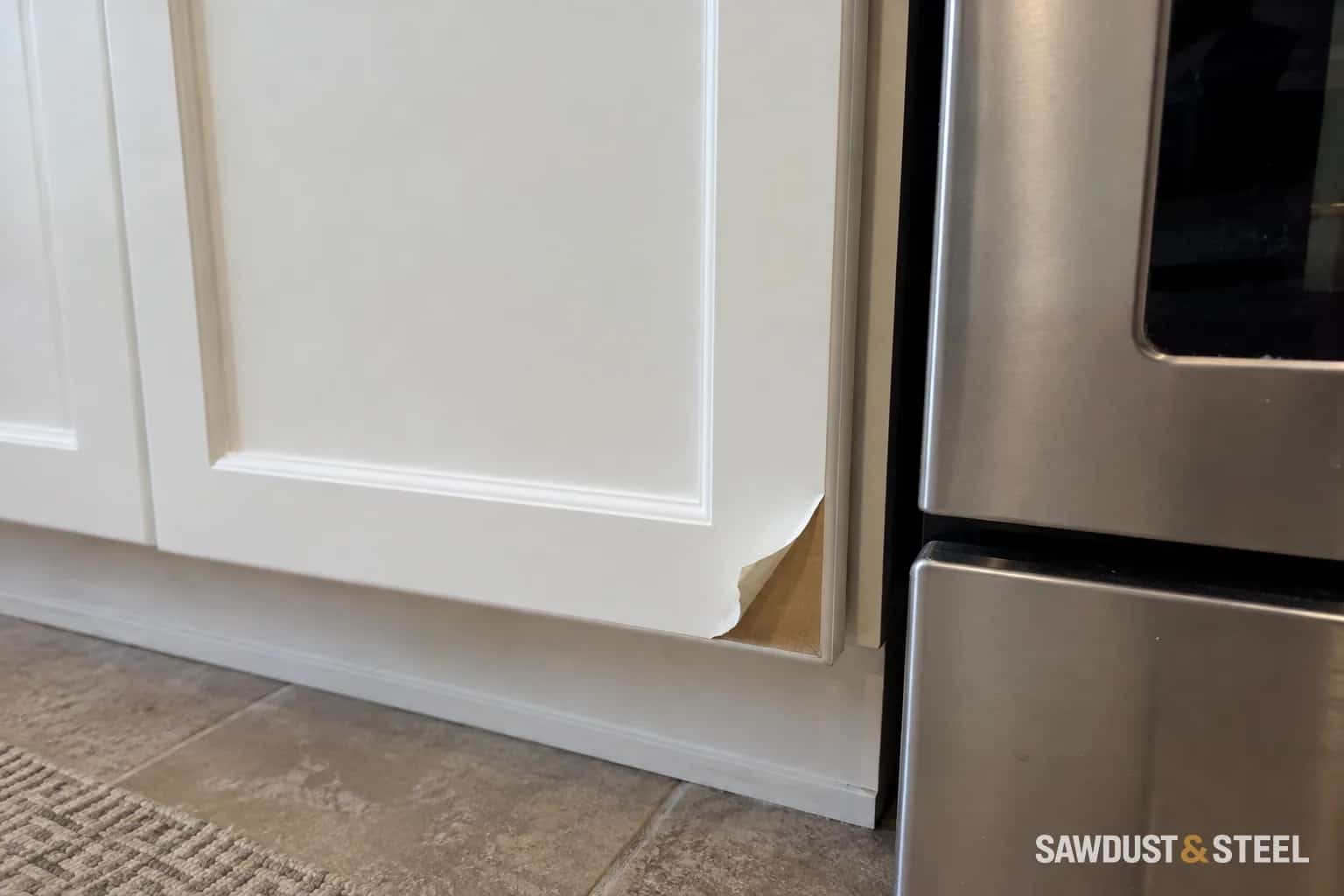
The corner of the cupboard door curls away beside the oven. It is tempting to press it flat with a hot iron, particularly if you have recently repaired a strip of shelf edging. Stop long enough to identify the finish. A moulded foil skin is not the same material or assembly as iron-on timber edging.
Check whether the surface is foil, veneer or paint
Thermofoil doors have a plastic film formed over the shaped face and edges of a core, commonly a wood-based board. Look at an already exposed area and the back of the door, or find the cabinet order and manufacturer. Do not pull off more film merely to make identification easier.
A veneer has a wood layer; paint tends to chip or flake rather than peel away as a continuous moulded skin. If only the narrow edge of a flat panel is coming loose, use the edge-banding guide. Its repair options should not be transferred to an entire wrapped door.
Inspect the backing and the pattern of damage
Compare the damaged edge with a sound one. Is the core flat and firm, or thicker, crumbly or soft? Does the foil lie back in its original position without stretching? Has it shrunk away from the edge, cracked around a profile, or detached across a large area? Take close photographs before cleaning, gluing or removing anything.
| What you find | Useful next decision |
|---|---|
| Small released area; sound core; film still fits | Ask the cabinet maker whether a compatible local repair is supported. |
| Curled or shrunken film that no longer covers the edge | Compare a replacement front; adhesive cannot restore missing coverage. |
| Swollen or deteriorated core | Investigate moisture and assess replacement rather than hiding damaged board. |
| Several fronts affected beside one appliance | Check the installation and heat exposure before buying matching doors. |
| Sound boxes but widespread front damage | Price coordinated replacement fronts or refacing against a full cabinet change. |
These are repair choices, not a diagnosis from colour alone. Heat, moisture, original bonding and prior cleaning can contribute. A photograph of the whole cabinet run often tells the supplier more than a very close photograph of one curled corner.
Check the heat source before replacing the door
KraftMaid's care guide gives specific precautions for foil finishes near appliances and discusses heat shields beside thermofoil or laminate fronts. Merillat's care guidance also warns that escaping heat from a self-cleaning oven can damage adjacent cabinets.
Check the appliance installation and door seal through its manufacturer or service provider, and ask the cabinet supplier whether its heat protection detail was required and fitted. Use the compatible detail for those cabinets and that appliance. An improvised sheet or trim piece must not obstruct an oven vent or change the specified clearances.
Notice countertop appliances too. A kettle or toaster oven parked directly below the damaged front may expose it to repeated heat or moisture. Moving the appliance to a suitable operating position can matter more than changing the door material. Keep storage and operating clearance separate.
If the range needs to be moved for service, have its anti-tip device checked after it returns. Do not pull a connected appliance out simply to inspect the cabinet edge behind it.
Choose the repair with its limits understood
Do not start with a heat gun, solvent or a general-purpose glue. More heat can distort the film, and the wrong cleaner can affect the finish or bond. For a supported local repair, use the supplier's preparation, adhesive and clamping method. If the film is no longer the right shape, acknowledge that limitation before spending time on it.
A replacement front can preserve a good cabinet box. Record the door dimensions, thickness, hinge cup positions, handle holes and any special profile. Obtain an actual finish sample: an older white door and a newly made white door may not match. Where one replacement stands out, replacing a small coordinated group may look better than replacing the whole kitchen.
Stripping the film and painting the exposed core is a separate refinishing project, not a quick glue repair. Ask a refinisher to assess the substrate, profiles and achievable finish before choosing it. Compare that quotation with a new front and retain any warranty evidence before altering the damaged one.