
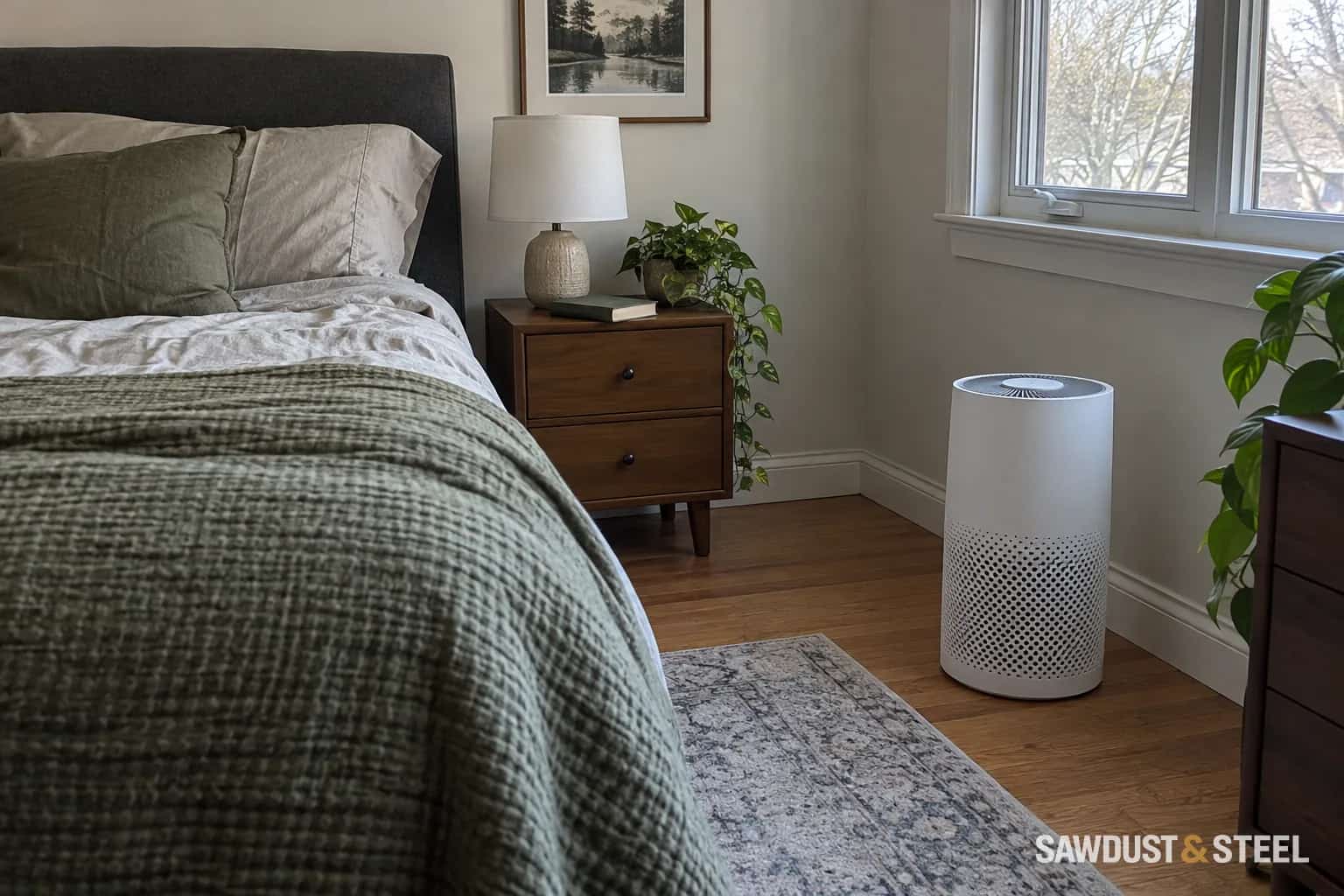
One air-cleaner box promises a huge coverage area. Another prints three CADR numbers in small type. Neither tells you immediately whether the machine will be useful beside your bed at a noise level you can live with. Start with the room and the rating conditions before comparing sale stickers.
Choose the room you intend to protect
Measure its length and width and note the ceiling height. A bedroom that can be closed off is a different space from a living room open to a kitchen, stairwell and upper landing. Do not count on one portable machine filtering every separated room simply because the whole dwelling fits a headline square-footage claim.
Choose a room where people spend time and where safe temperatures can be maintained. Identify a practical location with an electrical connection and clear inlet/outlet airflow according to the manual. If the only available position is behind a sofa and curtain, solve placement before ordering the machine.
Read smoke CADR with the correct units
CADR means clean air delivery rate. Health Canada's portable air-cleaner guide recommends looking for AHAM certification and using the tobacco-smoke CADR when assessing fine-particle removal, including wildfire particles. Its general minimum sizing guideline is a smoke CADR of at least two-thirds of room area in square feet, assuming an 8-foot ceiling. Higher ceilings need a unit rated for a larger room.
AHAM's filtration guidance makes a more demanding recommendation specifically for wildfire smoke: smoke CADR equal to room area in square feet, using the same ordinary ceiling-height basis. For a smoke-focused purchase, compare against that higher recommendation rather than treating the general two-thirds rule as a universal wildfire target. Actual conditions, room connections and the speed used still matter.
| Room at an 8-foot ceiling | Health Canada general minimum | AHAM wildfire recommendation |
|---|---|---|
| 10 by 12 feet: 120 square feet | 80 cfm smoke CADR | 120 cfm smoke CADR |
| 12 by 15 feet: 180 square feet | 120 cfm smoke CADR | 180 cfm smoke CADR |
| 15 by 20 feet: 300 square feet | 200 cfm smoke CADR | 300 cfm smoke CADR |
Keep the units straight: this calculation uses square feet and a CADR expressed in cubic feet per minute, or cfm. Do not insert square metres into it. If a listing uses cubic metres per hour, compare the same units; 100 cfm is approximately 170 cubic metres per hour. Prefer a clearly stated smoke rating to a coverage claim with no air-change or fan-speed basis.
Check how much airflow you will actually use
A high maximum rating is useful only if the machine can run where you need it. Ask which speed produced the published CADR and whether lower-speed performance is available. Listen to the unit if possible, or read the manufacturer's noise specifications with their test conditions. A quiet night mode and maximum filtration are not automatically the same setting.
- Find the exact model in the certification directory rather than relying on a similar product name.
- Check current replacement-filter availability and the cost of keeping spare filters.
- Confirm how the unit indicates filter maintenance and what the manual says during heavy particle loading.
- Avoid ozone-producing devices; do not assume every added ionization feature is necessary.
- Check that controls can remain in the intended mode after a power interruption.
An HEPA label describes a filter, while CADR also reflects airflow through the device. Activated carbon may help with some gases, but a thin carbon layer is not a promise to remove all smoke gases or odours. Health Canada notes that widely used performance ratings for gas-removal filters are lacking.
Use filtration as part of the smoke-event plan
Health Canada's wildfire guidance advises keeping smoke out where possible, using appropriate filtration and prioritizing cooling when extreme heat and poor air quality coincide. If the home cannot stay cool and cleaner with windows closed, seek local information on cleaner-air spaces rather than remaining in an overheated room.
Run the cleaner with unobstructed airflow and the highest practical setting consistent with its instructions. Check current AQHI information, smoke alerts and local advice when deciding about outdoor-air ventilation. Do not seal required vents, disable safety equipment or improvise a tighter furnace filter than the system can handle.
An HRV or ERV moves outdoor air; a portable cleaner recirculates and filters room air. The cleaner does not remove the moisture from indoor drying laundry, and a dehumidifier is not a smoke filter. These devices can have complementary jobs without being substitutes.
Keep the room plan realistic
Record the room dimensions, selected model, smoke CADR, usual fan setting and filter part number in one place. That makes the next purchase or replacement easier. Reassess if the room becomes open to a larger area or the cleaner is moved elsewhere. A useful filtration plan specifies where and how it works; it does not promise that a product name makes the entire house safe.