
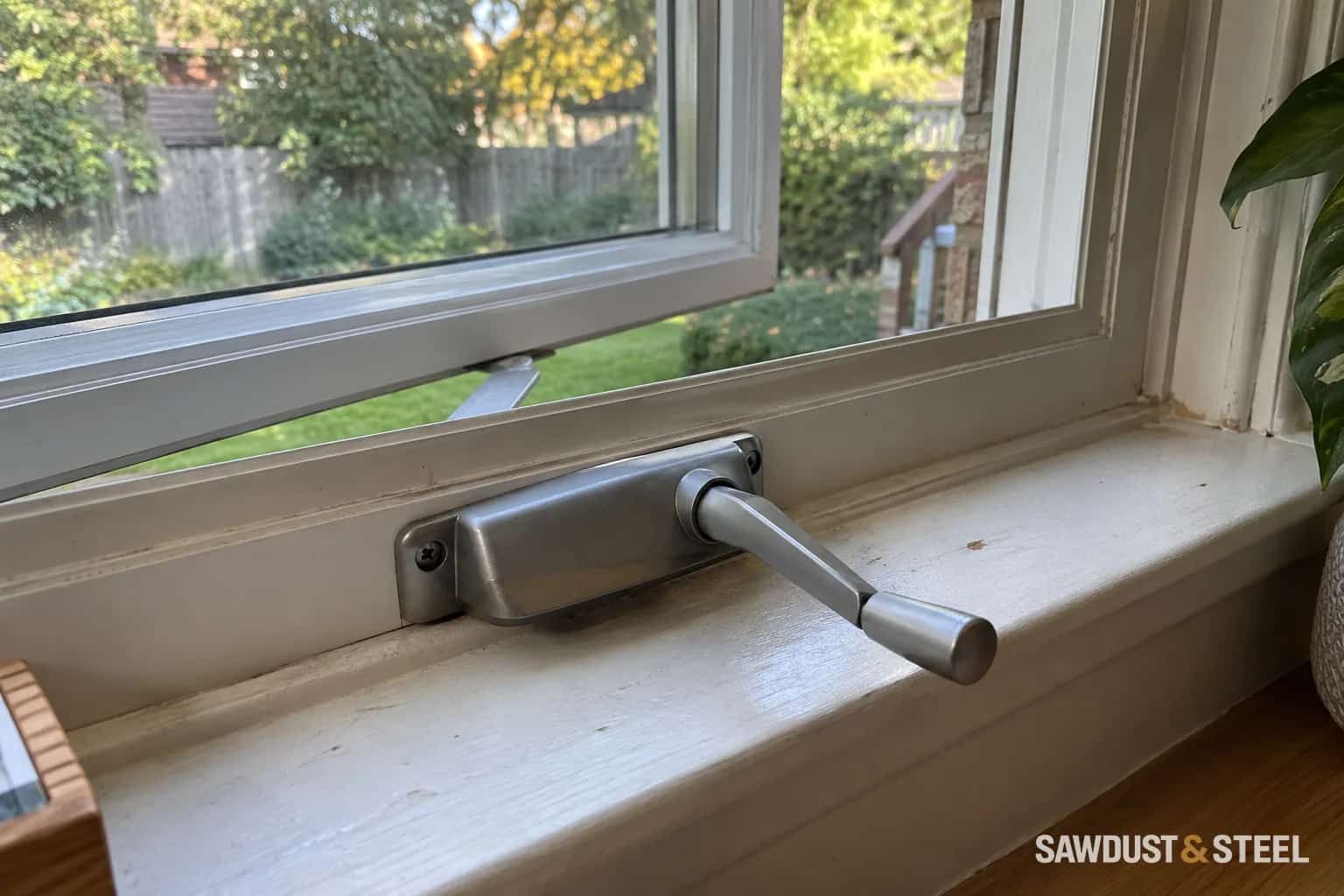
Check the simple obstruction first
Confirm every lock is released, including a second lock on a tall window. Move curtains or blinds away from the handle. Turn gently and note whether the handle spins with almost no resistance, catches intermittently, or meets firm resistance. Stop if you hear grinding or see the sash twist. More force can turn a small hardware fault into damaged gears or a bent arm.
Andersen distinguishes the operator, its handle on the spline shaft, and the cover over the mechanism; a loose handle is not the same component as the operator Andersen: Casement and awning window operators.
Photograph the hardware and any product labels before removing anything. A handle may use a retaining screw or a different attachment, depending on the model. Check its service instructions rather than gripping the exposed shaft with pliers. Damaging the splines makes it harder to fit a sound replacement handle.
Find where rotation stops becoming movement
Handle
Does it grip the shaft or slip around it?
Operator
Does the mechanism move its arm without grinding?
Arm connection
Is the linkage correctly connected to the sash track or bracket?
Sash and hinges
Can the assembly move without dragging or twisting?
A service technician can use these observations to distinguish a handle replacement from an operator or hinge repair. Do not detach the operator arm just to see whether the window swings freely. On an outward-opening sash, wind and gravity become part of the job once a controlling component is disconnected. Upper-storey access adds another reason to arrange proper service.
Match the mechanism, not just the handle colour
Record the brand, series, approximate date, handing, arm configuration and mounting details. Compare parts diagrams for that product. Straight-arm and split-arm operators are not interchangeable because they look similar under the cover. A supplier may need a photograph with the sash open, but do not force a failed window open to obtain it; start with the identification available safely.
Andersen's A-Series sash-adjustment guidance links dragging and poor locking to sash alignment, with different instructions for the relevant operator arrangement Andersen: A-Series casement sash adjustment.
That matters when the crank became progressively harder before it failed. Replacing an operator without correcting a dragging sash can leave the new part fighting the same resistance. Ask the repairer to check the hinges, track and weatherstrip as well as the visibly failed hardware.
Check closing and locking too
The repaired window should open smoothly, close evenly and lock without using the latch as a winch. Verify the insect screen and handle do not interfere with each other. If the window closes but the lock still misses, follow the lock-alignment guide. A fogged sealed unit is a separate issue; glass versus window replacement helps keep those decisions distinct.