
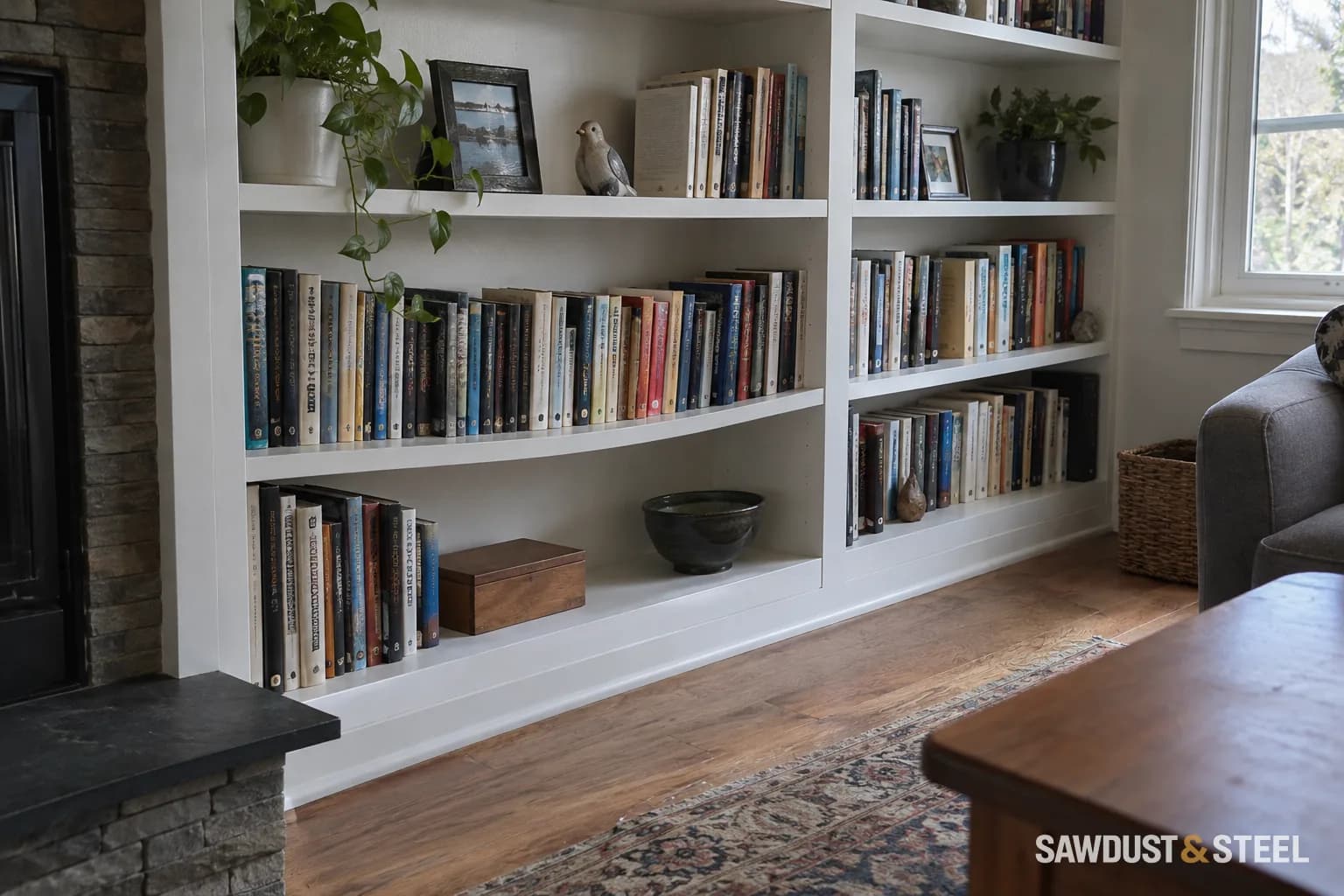
In a living room, Bea approves long, slim shelves with a few ceramics on the drawing. Then she unpacks the books. Three months later the lower shelf curves gently beneath cookbooks she mostly reads for the photographs. The styling plan and the load plan were different documents. Only one existed.
The bracket and the shelf have different jobs
A fixing transfers load into the wall or cabinet. The shelf itself has to span between supports without unacceptable bending. You can have strong fixings and a sagging board, or a stiff board attached badly. Both need checking before adding more weight.
Manufacturer ratings are specific to the product and installation. IKEA Canada's 120 cm BERGSHULT shelf guidance gives different limits for two and three brackets: 22 lb and 44 lb respectively, with proper mounting and evenly distributed weight. Its two-bracket arrangement also specifies bracket spacing. Those numbers do not transfer to a custom shelf of similar size. Ask the maker what load and support arrangement the actual design allows.
Make a load note the cabinetmaker can use
Put a representative row of the intended books in a box on a household scale, subtract the empty box's weight and record the row's length. This gives the designer something more useful than 'a few books'. Do not load a damaged shelf to test it. Include the heavy serving bowl or record collection separately; one concentrated object is a different arrangement from an evenly filled row.
| Record | Why it changes the repair |
|---|---|
| Clear distance between each pair of supports | A wide cabinet may contain several shorter spans. Measure the longest unsupported one. |
| Board thickness, depth and construction | Solid wood, plywood and particleboard are different design inputs; a painted edge may hide the material. |
| Actual contents, approximate weight and position | A centre stack and an evenly spread row do not load the shelf in the same way. |
| Photos of the empty shelf and every connection | A bowed board, loose bracket and damaged pin hole need different repairs. |
For an existing installation, photograph the unloaded shelf against a straight reference without pushing it back into shape. Note whether the cabinet sides or brackets have moved too. Ask for a repair drawing that identifies the support below a new divider, the replacement shelf and the intended contents. A divider has to carry its load somewhere sound.
Bring the books to the design brief
- Describe the contents: paperbacks, heavy art books, records, dishes, or display objects.
- Measure the clear span between supports, not simply the cabinet width.
- Confirm material, thickness, edge reinforcement, and support details together.
- Ask whether the load allowance assumes even distribution or concentrated objects.
- Keep wall anchorage and anti-tip requirements separate from shelf-bending checks.
| Possible change | What you give up |
|---|---|
| Add an intermediate divider | The long uninterrupted line. |
| Use a thicker or reinforced shelf | Some visual lightness or additional cost. |
| Reduce the span | A different cabinet rhythm or fewer wide openings. |
| Reduce the stored load | Some storage capacity; useful immediately, but not a repair for failed fixings. |
Do not reverse a damaged shelf and call it repaired
Unload it first. Have the shelf and its connections inspected, especially if fixings are pulling out, the material is cracked, or the sag is increasing. Simply flipping a board may change its appearance without addressing the cause or restoring its original condition.
If the board itself is sound but a support has fallen out, inspect the shelf-pin hole and surrounding panel. Repairing that connection needs a different plan from stiffening a long span.
For Bea's redesign, we measured a row of her actual books and used that load in the revised shelf plan. The centre divider needed support down through the cabinet; putting a prop on another flexible shelf would only move the problem. She lost the long uninterrupted opening, but gained two useful bays. The heavy cookbooks went back in after the damaged shelf was replaced, not before.
If the repair changes the whole cabinet, take the actual contents into the built-in planning and costs guide. It helps turn a shelf problem into a useful drawing. For the visible trim, compare material choices; for the wall connection, the support lesson from floating vanities shows why the hidden fixing detail needs its own plan.
Before replacing a bowed shelf, compare fixed and adjustable shelf support. A floating shelf also needs its bracket, wall backing and load checked together.