
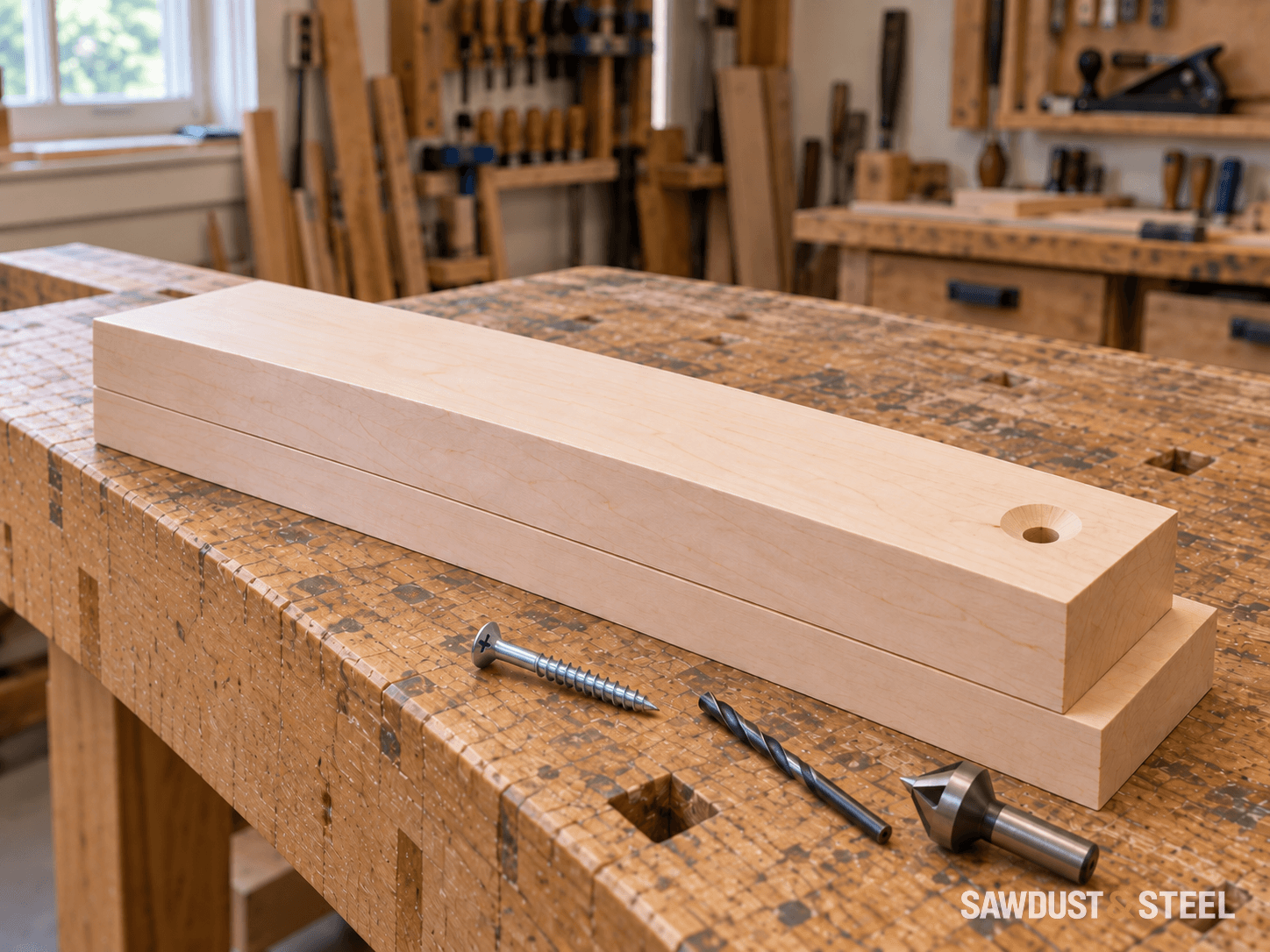
You drive the screw until its head looks settled, but daylight remains between the boards. More torque makes the driver complain and the gap look increasingly personal. Stop there. A screw can engage both pieces before they meet, holding them apart instead of drawing them together.
This guide covers ordinary screwed furniture and small woodworking joints. Structural connectors, pocket-hole systems, masonry fixings and proprietary cabinet screws have their own requirements. Keep their specified fasteners and installation details; do not substitute a general workshop hole pattern.
Give each part of the screw a job
At the face
Head seat
A countersink suits a matching flat head. Other head shapes may need a flat bearing surface.
Attached piece
Clearance hole
Lets the relevant part of the screw pass without holding this piece away from the joint.
Receiving piece
Pilot hole
Prepares the wood for the threaded part while retaining the material needed for grip.
Woodcraft's screw guide explains the role of upper-piece clearance in preventing bridging and distinguishes pilots for traditional tapered screws from those for straight-root production screws. Look at the screw you will actually use, not an unrelated screw pictured on a generic chart.
Choose the screw before choosing the drill
Check the material, thickness of both pieces, required penetration, head shape and the screw maker's guidance. Lay the screw beside the assembly and account for where its head will finish. A deep recess increases how far the point reaches beyond the upper surface. Avoid a length that threatens the visible face or concealed hardware.
A pilot that is too small can demand excessive driving force or split the wood. One that is too large can leave inadequate thread engagement. Species, density, edge position and screw geometry all matter. Use the specified drill size and depth, then make a sample joint in matching offcuts before drilling a finished part.
Do not send the clearance bit through everything
The upper piece needs freedom to draw down, while the receiving piece needs grip. Keep those drilling depths separate. A large clearance hole carried through both pieces can give the screw very little wood to hold. Mark the parts and set a physical depth control where appropriate; a guess becomes harder to maintain at the last hole in a row.
For a sample, prepare the receiving pilot and upper clearance according to the fastener guidance, hold the mating faces together securely, then drive slowly with the correct bit. The head should seat with the joint closed and without crushing the surface. If it spins, splits the wood or leaves a gap, stop and change the setup on scrap. A stronger driver is not the first adjustment.
A combination bit may combine the wrong two operations
Read the bit description carefully. Lee Valley's 82-degree HSS drill/countersinks make a shaft-clearance hole and a countersink. Their centre cutter is not a promise of the correct thread pilot for the receiving wood. By contrast, the company's carbide countersink drill units provide independently adjustable pilot and countersink depths. The shared word 'countersink' does not make the tools identical.
Check the head angle as well as its diameter. A shallow matching recess should seat the intended flat head without unnecessarily removing wood. A pan or washer head normally needs its intended flat bearing surface, not a conical hollow beneath it. Where hardware already provides a formed seat, use its specified fastener.
Rehearse with the same thicknesses and grain direction
Make the trial from the same material and thicknesses, with the screw entering the same grain direction and a representative distance from the edge. Secure the pieces and use eye protection. Check the finished face, the far side and the closed joint before repeating the settings on the work.
Keep the successful screw, bit and depth settings together until the assembly is complete. For a hole that is already stripped, change tasks: the stripped hinge-hole guide covers restoring a failed connection. Drilling the original pilot correctly and rebuilding a damaged hole are different jobs.