
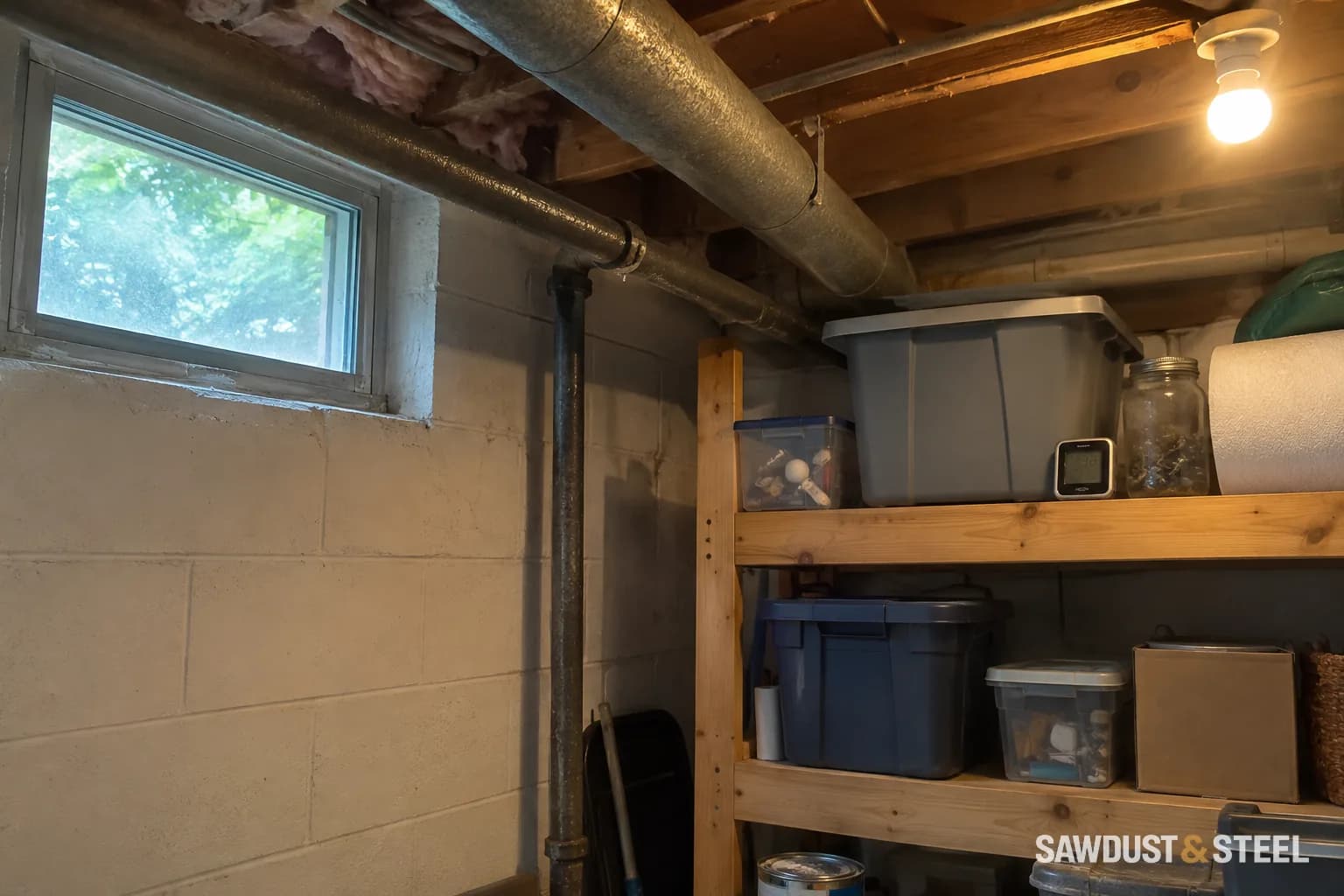
It smells a little damp, so the windows go open. On a muggy Ontario afternoon, that can invite more of the thing you were trying to remove.
Measure before changing the routine
Use a humidity meter and record indoor conditions over several days. Note whether dampness tracks rainfall, laundry, open windows, or weather. A single reading is less useful than the pattern.
Health Canada's moisture guidance recommends controlling indoor humidity and using dehumidification where needed. NRCan explains how humid air can condense on cold basement surfaces. Neither point means every closed basement needs the same equipment setting.
Humid outdoor air
An open window brings its moisture inside.
Cool basement surface
The incoming air cools against the foundation.
Possible condensation
Water forms if the surface is below the air’s dew point.
Compare moisture, not just percentages
An outdoor reading of 60% relative humidity is not necessarily drier than a basement reading of 65%. Temperature changes the comparison. The National Weather Service explains dew point as a more useful indicator of how much moisture the air contains: a higher dew point means more moisture.
For a window-opening decision, compare indoor and outdoor dew points if your instruments provide them. Lower outdoor dew point offers drying potential; higher outdoor dew point brings a wetter air supply. A cool wall can still collect condensation when its surface temperature is below the incoming air's dew point. The room's air temperature alone cannot rule that out.
Your weather app's dew point describes the outdoor air, not the basement. For the indoor value, use the room's temperature and relative humidity with a dew-point calculator, such as the National Weather Service calculator, or a meter that displays it. Keep both values in the same units. A cooler evening is not automatically a drier one.
| Outdoor dew point | What it means | Window decision |
|---|---|---|
| 18°C | The incoming air contains more moisture than the basement air. | Keep windows closed for moisture control; opening them adds a wetter air supply. |
| 12°C | The air has a similar moisture content despite any difference in relative humidity. | Do not expect airing to dry the basement just because it feels cooler outside. |
| 8°C | The incoming air has drying potential, but can still condense on surfaces colder than 8°C. | A brief airing may help if cold surfaces stay dry; recheck conditions rather than leaving windows open by habit. |
Separate air moisture from water entry
A dehumidifier may help with indoor moisture, but it does not repair a foundation leak, failed drain, or wet material hidden behind a wall. Investigate staining, persistent odours, or visible growth rather than trying to make the room smell neutral.
If the dehumidifier is running, close the basement windows. That is an explicit step in Health Canada's basement checklist. Otherwise, the unit can keep removing moisture while an open window supplies more. Keep using the home's intended ventilation; closing windows for humidity control does not replace it.
Droplets can also form on cold plumbing. Use the cold-pipe condensation and leak checks before insulating the line or closing a ceiling around it.
Make the room easy to monitor
- Keep the humidity meter in a representative location, away from obvious water sources.
- Check the dehumidifier's drainage and maintenance instructions if one is used.
- Use the intended bathroom and laundry ventilation.
- Record any persistent wet areas before covering walls or floors.
The practical aim is comfortable, controlled conditions, not keeping the windows permanently open or permanently shut. Let the weather and the room's behaviour inform the choice. The basement does not know that fresh air is supposed to be wholesome.
If you use a portable unit, place the dehumidifier where air can reach it and compare humidity away from its own display.