
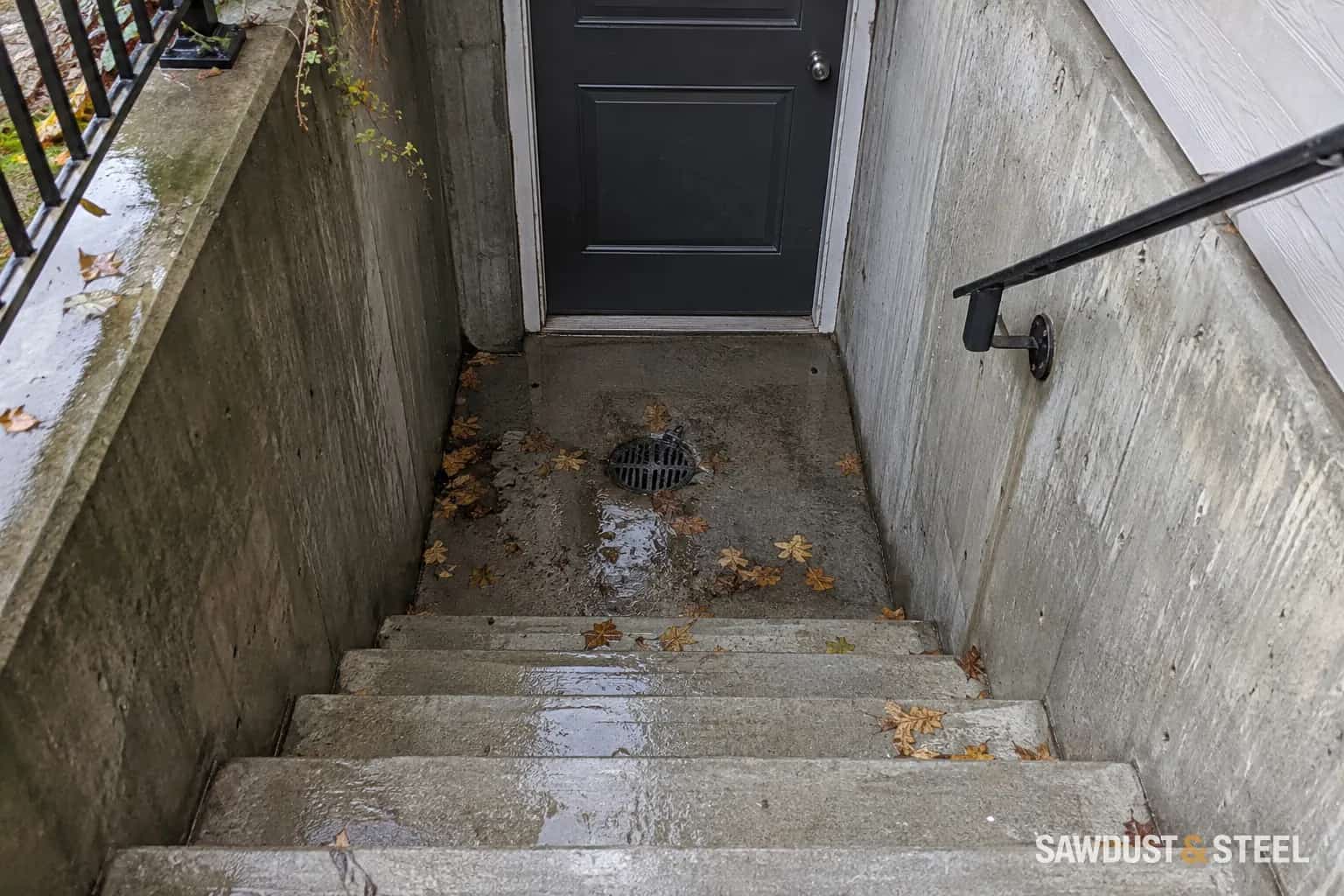
A basement walkout is a low spot with a door at the bottom. When the stairs collect water, a new door sweep is unlikely to be the whole answer. Start by finding how water arrives and where the stairwell drain is supposed to send it.
A grate visible in the landing does not tell you the destination. The drain may connect to a system that needs investigation, and its behaviour during a storm may differ from a small test on a dry day. Do not assume it reaches the storm sewer, sanitary sewer or sump simply because one of those routes seems convenient.
Observe from a safe place
During ordinary rainfall, if conditions are safe, note whether water runs down the steps from the yard, spills from a nearby downspout or emerges through the drain. Photograph the route from above rather than entering a deep or contaminated pool. Water rising at the grate is a different clue from leaves covering an otherwise functioning inlet.
| Observation | Possible question | Useful next check |
|---|---|---|
| Water runs down from the yard | Is the stairwell receiving avoidable runoff? | Review grading, paving and downspouts |
| Water ponds over a covered grate | Is the surface inlet obstructed? | Clear ordinary debris safely and assess drainage |
| Water rises through the grate | Is the downstream route restricted or surcharged? | Have a plumber identify the connection and cause |
| Drain clears but door still leaks | Is the threshold or adjoining wall defective? | Assess the entry assembly after drainage is understood |
Toronto: basement flooding distinguishes overland water, foundation entry and sewer backup among basement-flooding mechanisms. Its guidance supports investigating drainage and using qualified plumbing help where needed. That distinction matters here: enlarging a grate will not resolve every source of rising water.
If water has entered the basement, address safety and cleanup first. Avoid electrical hazards and arrange appropriate restoration for contaminated water. The exterior diagnosis can proceed alongside the indoor assessment; post-flood rebuilding explains why finishes should wait for verified conditions.
Trace the drain before changing it
Ask a qualified plumber to establish the drain route, condition and discharge arrangement. Depending on access and the suspected problem, that may involve records, inspection or appropriate testing. Keep a sketch of the confirmed route rather than relying on a verbal explanation that disappears when the visit ends.
Check what can be maintained from the landing and what needs professional access. Removing ordinary surface leaves is very different from opening an unknown drain connection or trying to force a blockage through it. Do not pour chemicals into a drain whose destination you have not established.
If the drain relies on a sump, include the pump, controls and exterior discharge in the investigation. A functioning inlet is only the beginning of that path. Checking the sump before a storm helps you ask for a complete functional check.
Reduce unnecessary water arriving at the stairs
Look at the top landing, adjoining paving, yard grade and roof runoff. Ask whether they direct water toward the stair opening. A change in landscaping or a replacement patio can alter the route even if the stairwell itself has not changed.
Have grading or paving changes designed to avoid transferring water onto a neighbour's property or another vulnerable part of your house. A little ridge across a walking route can create drainage and access problems of its own. Any proposed canopy also needs proper structure, flashing and an intended runoff route.
At the bottom, inspect the door threshold and wall junctions as parts of the assembly. Repairing those details may be necessary, but a threshold should not be expected to hold back a stairwell full of water. Manage the catchment and discharge before treating the door as a miniature flood barrier.
Test the repaired route, then maintain it
Have the responsible contractor explain how the repair will be checked without deliberately flooding the entry. Confirm what was observed at the inlet and discharge, and record any limitation of the test. A modest controlled test does not prove performance in every future extreme event.
Keep the grate accessible rather than covering it with a mat, planter or storage bin. Include leaves, snow and ice in seasonal checks, using methods that do not damage the drain or make the stairs slippery. Revisit the area after significant rain and after nearby landscape work.
The most useful repair description is specific: runoff was redirected, a confirmed drain route was restored, and the door junction was repaired. "Waterproofed the walkout" leaves too many unanswered questions about the next storm.