
The drawing looks wonderful. Where does the vacuum go? That question can change a built-in more than another foot of shelving. Books, coats, files and a television need different depths, supports, doors and wiring. Bring a short list of what must fit before asking for a price per foot. It gives us something useful to build around, including the things you would rather hide.
What changes the cost of a custom built-in?
| Cost driver | Simpler scope | More involved scope |
|---|---|---|
| Storage | Fixed open shelves | Drawers, doors, pull-outs, filing hardware, or concealed equipment |
| Construction | Straight wall, standard depths, overlay fronts | Inset fronts, curved work, unusual depths, or several fitted corners |
| Finish | One common painted colour | Natural veneer, stain matching, high-gloss work, or several samples and colours |
| Site work | Clear wall with nearby power | Heavy scribing, demolition, floor repair, vents, stone, plumbing, fireplace, or electrical changes |
| Installation | Easy access and a short straight run | Tight stairs, condo rules, long walls, tall ceilings, or phased trade coordination |
Which built-in types are simpler to price?
A straight mudroom bench or open bookcase usually has fewer moving parts than a full-height library wall with closed cabinets. Banquettes add seating geometry, upholstery, and access to storage. Under-stair work looks small but every drawer can be a different shape. Fireplace walls bring clearances and regulated trades into the same conversation. Start with the daily problem the built-in must solve, then remove features that do not help solve it.
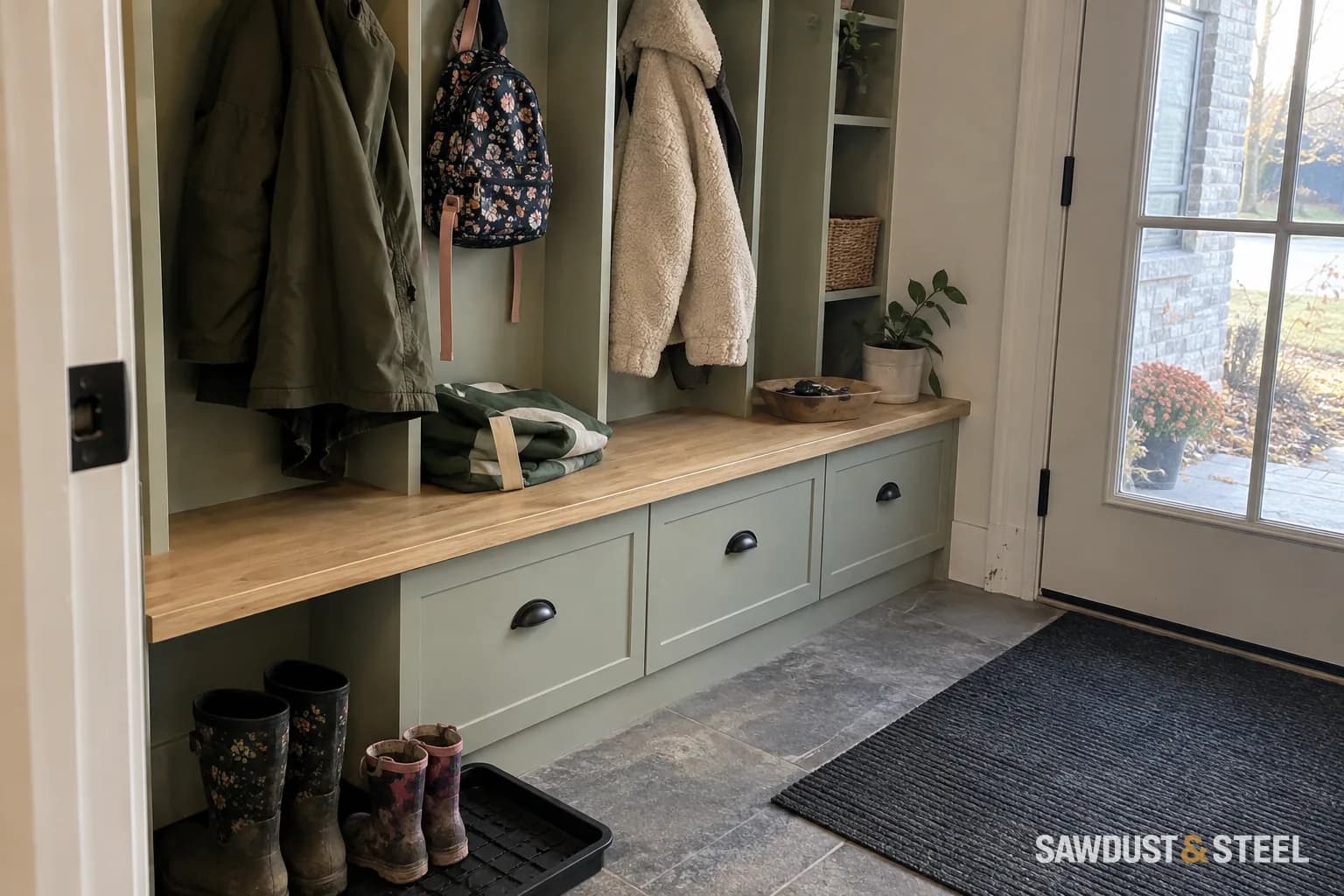
A mudroom quote should identify seating, cubbies, doors or drawers, hook backing, finish, floor protection, and wall repairs.
What construction details should the quote name?
Ask for the case, back, shelf, face-frame, door, drawer-front, and edge materials. Record thicknesses, adjustable versus fixed shelves, drawer construction, hinges, slides, pulls, ventilation openings, anchoring, and expected loads. The finish section should name the preparation, product type, colour or stain sample, sheen, shop versus site work, and touch-up plan. Our MDF, poplar, and pine comparison helps with visible painted trim, while cabinet boxes and doors need their own specification.
Existing houses add fitting work. Walls bow, floors slope, outlets land behind dividers, and existing baseboards need to meet the new work. The quote should state where fillers or face frames are scribed to the room, which existing trim is reused, and who repairs the wall and floor after removal.
How do lighting and fireplaces affect the quote?
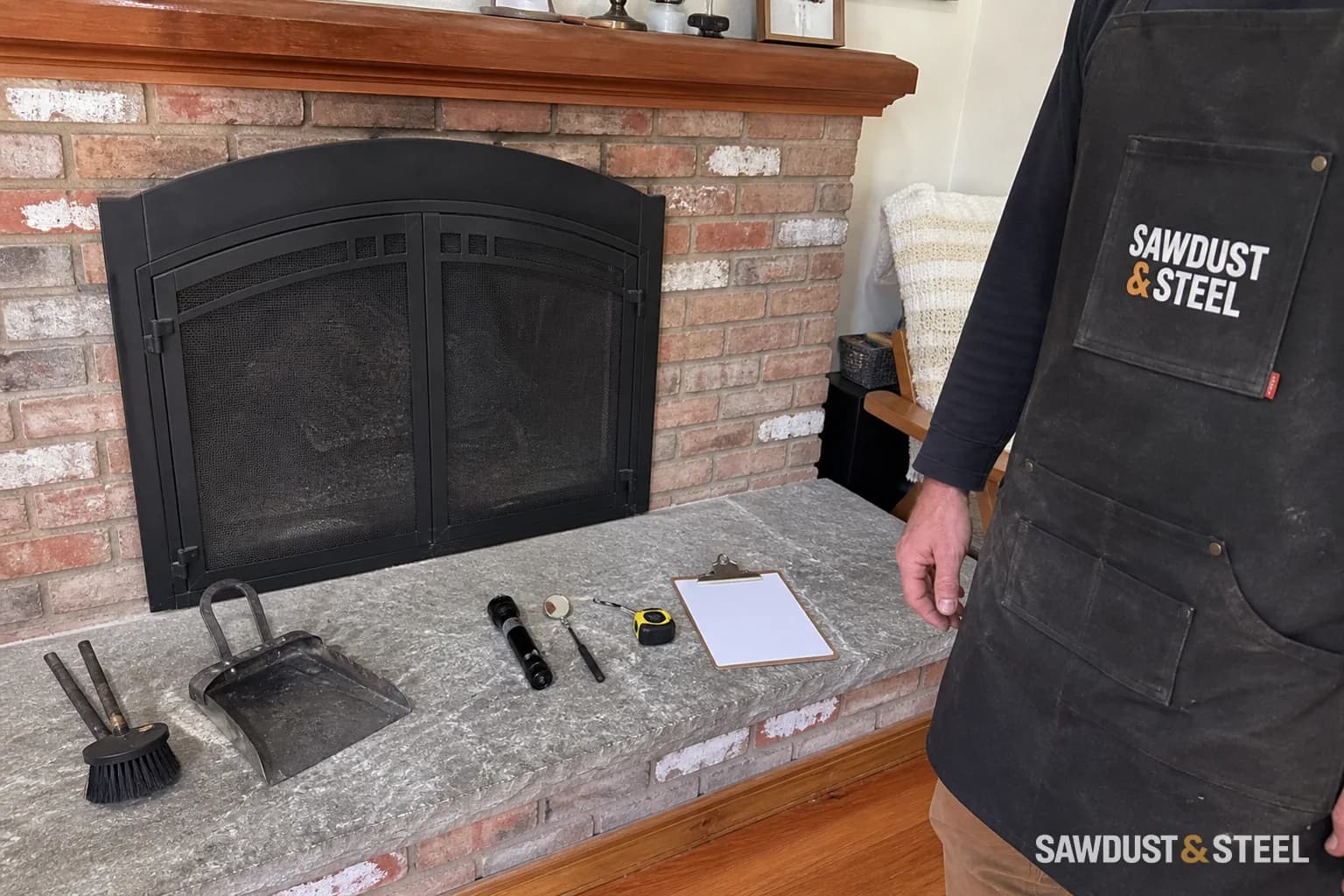
Integrated lighting needs an electrical plan before cabinet fabrication, including driver access, switching, wire routes, heat, and serviceability. Ontario homeowners should verify the electrical business through ESA's hire-and-verify guidance. A gas fireplace or gas-line change belongs with a TSSA-registered fuels contractor, searchable through TSSA's contractor directory. The cabinetmaker coordinates openings and clearances with the regulated trades.
How should you compare built-in quotes?
Give every bidder the same measured concept and ask them to mark assumptions. Compare design revisions, materials, doors and drawers, hardware, finish, delivery, protection, installation, electrical or other trade work, tax, warranty, and exclusions. If one price is much lower, compare the storage layout as well as the materials. Replacing drawers with doors may explain some of the difference. On a hallway unit, the lower quote allowed two hinged cupboards where the drawing showed four deep drawers. Both offered closed storage, but only one let the owner reach the back without kneeling. We marked that difference on the same elevation before discussing materials. A lower price can be a useful option once you know which part of daily use changes with it.
| Item | Example amount before tax | What it buys |
|---|---|---|
| Agreed cabinet scope | CAD 8,000 | The precise drawings, materials and installation attached to the quote |
| Approved drawer upgrade | CAD 600 | The documented difference from the included doors |
| Separate electrical quotation | CAD 450 | Only the electrical work listed by that contractor |
| Working scope subtotal | CAD 9,050 | 8,000 + 600 + 450; apply the actual tax treatment separately |
The arithmetic shows how to reconcile a budget using assumed quote amounts; it does not establish a market average or predict the price for your room. Keep an owner-held contingency outside the signed scope total. If your budget cannot carry the preferred design, request priced alternates for drawer count, finish and lighting while retaining the support and access details. Compare the same elevation in each quote so the saving is attached to a visible choice.
What should happen before fabrication starts?
Approve a dimensioned drawing, door and drawer layout, material samples, colour and sheen, hardware, electrical locations, appliance or fireplace specifications, and the final price and schedule effect of revisions. Confirm site access and what must move. Mark small but important items too, such as a charging socket or space for the vacuum.
Left opening
Measure front and rear widths at floor, cabinet top and upper shelves; do not copy the right side.
Shared datum
Mark the intended lower-cabinet top line across both alcoves for a balanced view.
Right opening
Allocate shelves to its actual books, records and equipment; let the useful divisions differ.
Services and base
Mark outlets, heater/fireplace clearances and the floor/base construction separately.
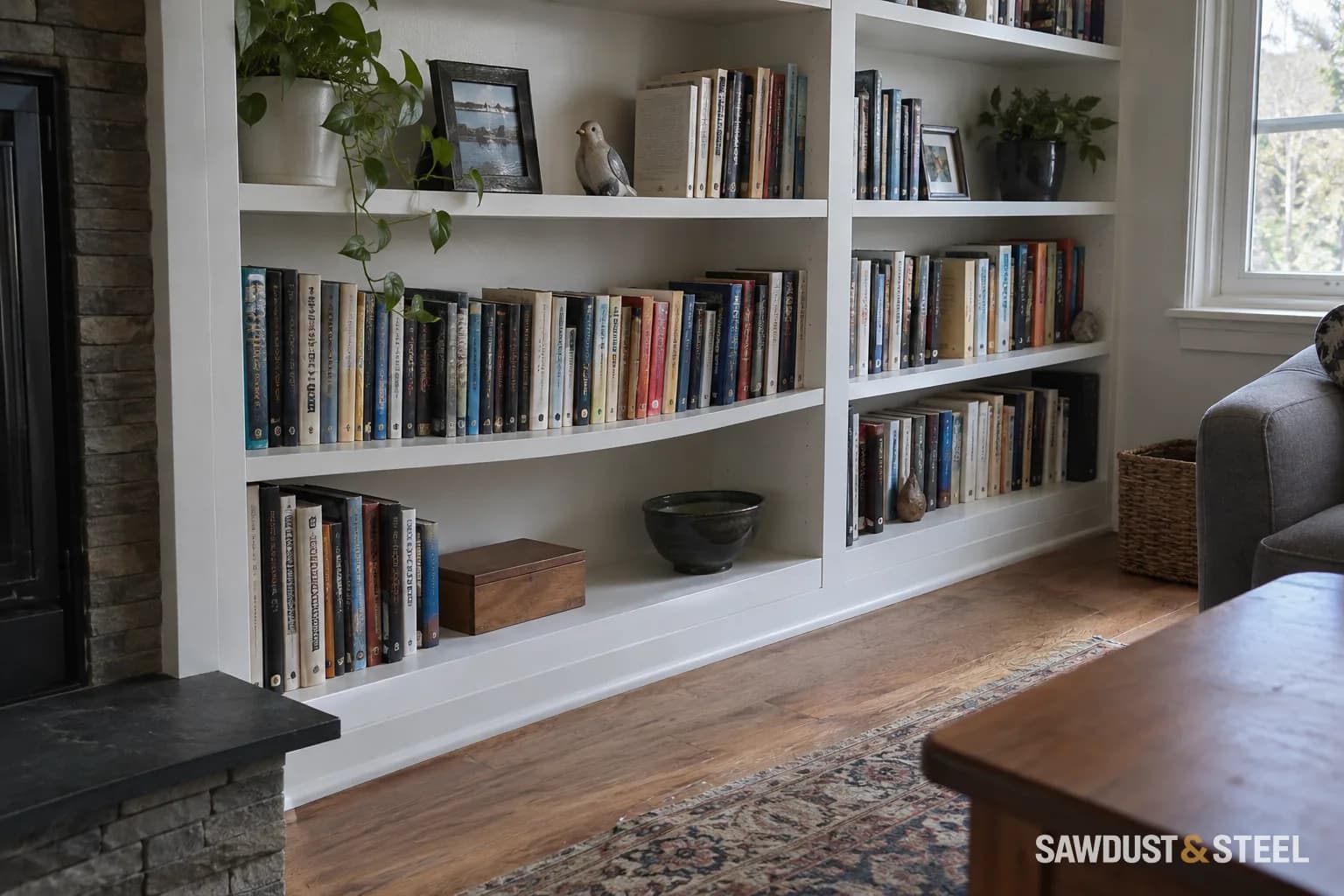
For a paper elevation, assume the left alcove measures 900 mm across its narrowest usable point and the right measures 1,200 mm. Draw both lower cabinet tops on the same 750 mm line above the finished floor. Keep that horizontal line and the finish consistent, but divide the upper left opening into two equal nominal 450 mm zones and the right into three equal nominal 400 mm zones. The visible vertical divisions differ while the lower top line ties the pair together. These are layout zones before deducting cabinet sides, dividers, fillers and installation tolerances, not clear shelf spans or a construction specification.
Now place the actual contents on that elevation. If a 500 mm-wide record player belongs on the right, replace its three equal zones with a nominal 600 mm equipment zone and two nominal 300 mm display zones, then confirm the actual clear width after the construction deductions. Taller art books on the left can have a different shelf-height pattern without moving the shared lower-cabinet top. Compare both drawings from the sofa; forcing identical divisions would waste the unequal openings.
Measure the differences before hiding them
Get the openings measured at several heights and depths. Include skirting, cornice, outlets, and any required clearances around a fireplace or heater. The finished design must follow the appliance requirements where those apply; a balanced photograph cannot override them.
Matching lower cabinet heights and a shared finish can create order without making every shelf identical. In an older living room, the right alcove narrowed toward the back and held the owner's record collection; the left needed room for taller art books. Forcing identical shelf divisions would have wasted space on both sides. We matched the lower door line, then let the shelves above do different jobs.
Use the books you own
Lay out books, records, baskets, speakers, and the things you would rather conceal. A tall art book has a more persuasive argument than an evenly spaced shelf grid. Give each side a job, then compare how much display area the room can comfortably carry.
IKEA’s bookcase and shelving range offers examples of open and closed combinations. These are planning references, not dimensions or support specifications for custom joinery.
Review it from the sofa
Print a simple front elevation and look from the usual seating position. On that job, a filler at the outside wall absorbed the crooked plaster, while the visible shelf fronts stayed square and aligned. We checked it from the sofa before making the last trim piece. A few shared lines usually matter more than identical box widths. Choose exact matching when it makes both sides useful.
Start with support and anchoring
Identify the furniture's installation instructions, the wall construction, and the floor condition. Carpet and underlay can affect how a unit sits; the installer should establish a stable base rather than using decorative trim to disguise movement.
Health Canada's tip-over guidance recommends securing furniture with appropriate anti-tip devices and following installation instructions. A full shelf of books is not a reliable anchoring strategy.
Decide what happens when the carpet changes
If the bookcase will become permanent, discuss how future flooring replacement can happen. If it remains furniture, make sure any added trim does not prevent the required anchoring or create confusion about how it is secured.
Keep the final installation practical
- Use anchoring suitable for the furniture and the actual wall.
- Place heavier items low, consistent with the product guidance.
- Do not obstruct outlets or other required access behind the unit.
- Record how trim can be removed without disturbing the anchoring unintentionally.
Recheck the installation if the furniture is moved or flooring is changed. A detail that was secure before a renovation may need to be reinstated afterwards.
Ask the installer to show you the attachment points and which trim pieces can come off for a future floor change. Keep that record with the furniture instructions. Once the base and anchoring are right, closing those awkward alcove gaps is the enjoyable part of the job.
Before closing the backs, check existing outlets and cable access behind built-ins on the same elevation.
Test a working day before a cabinet drawing
Use a temporary desk or stable table in the proposed position. Work there with your actual chair, screen, keyboard, and ordinary lighting. Notice reflections, the door behind you, background noise, and where you set a drink.
Do this across several days if possible. A client tried working at the proposed alcove for a week and found the afternoon reflection landed right over his second monitor. Moving the screen solved the glare but put his knees against the planned drawer pedestal. We kept the desk movable and shifted fitted storage above and beside it. It was a better use of the alcove than fixing the first drawing permanently in place.
Protect the person-sized space
CCOHS’s workstation guidance emphasizes adjustment to suit the individual. A fitted surface should not force your body to suit the joinery. Preserve legroom, practical screen placement, and a comfortable working height; plan adjustments appropriate to the user.
Bring cable routes, power access, equipment ventilation, and monitor-arm attachment into the design. Check the clamp underneath the top as well as the screen above it. On that work wall, a proposed rear rail occupied the clamp space, so the maker revised the detail before fabrication. Also try passing the actual plugs through the cable opening. A hole that neatly fits a wire may be too small for the part attached to its end.
Include the chair’s rolling area in either layout. Check casters, floor protection, and cleaning beneath a mat before the desk starts daily use.
Choose what can change
A built-in can be excellent when the location is proven and the fit creates useful space. A freestanding desk is often the better first answer for a new home office or shared room. You can still add fitted storage around it. Our preference is to make the part supporting the working day adaptable before making the whole wall permanent.
For a work wall, decide where the network equipment will live before closing the cabinetry. Hiding a router affects airflow, signal and service access.
Decide explicitly whether this is movable furniture on carpet or permanent cabinetry on a prepared plinth. For permanent work, agree how the base reaches a stable supporting surface and how carpet terminates at it; do not simply bury compressible underlay beneath a decorative toe-kick. Keep furniture anti-tip attachment independent of trim. Photograph the anchoring and identify removable trim so a future carpet installer can work without unknowingly releasing the unit.