
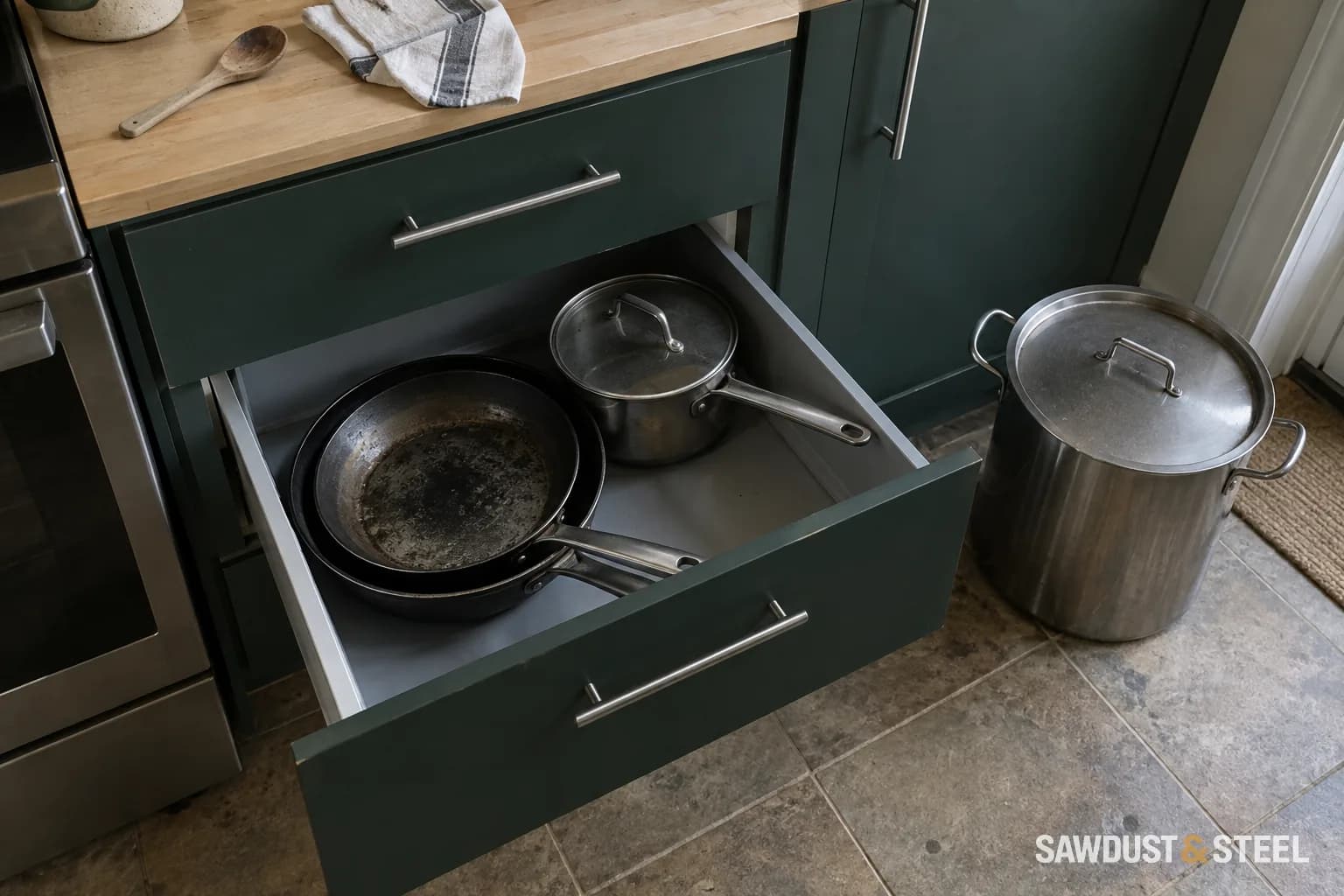
The expensive drawer is open. The stockpot is beside it. This is an awkward moment to discover that outside drawer height and inside storage height are different measurements.
Measure the inconvenient collection
Bring the biggest pan, the mixer bowl, the tall blender jug, and the stack of everyday plates into the planning conversation. On one kitchen, the stockpot fitted our proposed drawer until the owner put its lid back on. We changed the drawer arrangement before the order went in and kept a door cupboard for the mixer. Measure the usable clear height with the drawer installed, allowing for any rail, drawer, or other obstruction above it. The front height alone will not tell you what fits.
Drawers often make daily items easier to see. Cupboards can accommodate awkward heights with fewer horizontal divisions. Neither is automatically better throughout a kitchen. The mix matters more than winning the argument for one type.
Try the open version
At a showroom, open the drawer fully and stand where the cook would stand. Imagine another person crossing behind you. Try lifting a heavy pot from the proposed height, rather than just admiring how smoothly the empty drawer moves. For a door cabinet, reach to the back with a comparable item. If you have to remove two things to retrieve the third, reserve that space for equipment you use less often.
Ask for the internal dimensions and the rated load of the exact hardware. Blum's TANDEMBOX information describes full-extension access; that feature does not tell you whether your chosen cabinet fits your particular appliance. For heavy cookware, compare the complete drawer load with the hardware rating. If you are keeping the existing cupboards, retrofitting pull-out shelves needs a separate check of the door opening and hinges.
Spend the clever hardware where it helps
Our preference is easy access for the things lifted every day, with a deliberately sized cupboard for the odd-shaped equipment. Add dividers after deciding what belongs there. Buying an immaculate grid of organizers first is a surprisingly efficient way to organize the wrong kitchen.
Write down the usable space, not just the cabinet width
A nominal cabinet width is an outside dimension. Ask for clear internal width, front-to-back depth and height beneath the next obstruction. For example, a pot measuring 280 mm across its handles and 240 mm high with its lid needs an opening and storage space that accept that complete shape. A drawer with 220 mm clear height fails that particular test even if its front looks generously tall. Those are object-test dimensions, not a standard drawer specification.
Make a short inventory: item, quantity, largest dimension including handles, total loaded weight, frequency of use and proposed home. Put the most frequently lifted heavy pieces where the user can retrieve them comfortably. Include the drawer's own weight where the hardware maker's rating requires it. A rating for one runner family does not transfer to every drawer sold under the same brand.
| Stored item | Record | Try before ordering |
|---|---|---|
| Stockpot with lid | Height and handle width | Lift out without tilting against the drawer above |
| Stack of plates | Stack height and total weight | Retrieve the bottom plate without moving the whole stack |
| Mixer | Body, attachments and lifting grip | Lift from proposed shelf height |
| Roasting tray | Handles and rack together | Pass through the door opening without scraping |
Corner carousel or an unused corner: compare the whole run
Every square inch deserves a job. It does not follow that every square inch deserves a cupboard door. An awkward corner can consume a surprising amount of attention for somewhere you keep one roasting tray. A corner fitting also takes width from the adjoining cabinets. Compare what you can comfortably retrieve from the whole run.
Compare two complete cabinet runs
Compare two 2,400 mm-long cabinet runs meeting at a right-angle corner. Keep both wall lengths and the planned cabinet depth the same in the two drawings. The following is a geometry exercise using hypothetical cabinet envelopes, not a product installation layout. Widths are outside cabinet widths; useful drawer interiors will be smaller.
| Allocation on each wall | Corner mechanism | Unused corner |
|---|---|---|
| Corner | 1,000 mm | 650 mm |
| Filler | 50 mm | 50 mm |
| Adjacent drawers | 600 mm | 900 mm |
| Remaining cupboard | 750 mm | 800 mm |
| Total wall length | 2,400 mm | 2,400 mm |
On graph paper at 1:20 scale, each wall run is 120 mm long. Draw the corner allocations as 50 mm or 32.5 mm squares, the fillers as 2.5 mm strips, and the adjacent drawer widths as 30 mm or 45 mm. Both alternatives end at the same point on both walls. Closing the smaller corner allocation releases 350 mm per leg in this example: 300 mm goes to the wider drawer bank and 50 mm to the remaining cupboard. It sacrifices access to the corner volume. It does not create extra room or prove that either arrangement suits your kitchen.
Now replace those hypothetical envelopes with the cabinet maker's actual dimensions. The 50 mm fillers are arithmetic placeholders, not required or sufficient clearances. Handles, door arcs, hinge projection, wall irregularities and the mechanism's moving envelope can require a different allocation. Draw them open before accepting the apparent drawer-width gain.
For a real fitting constraint, IKEA's UTRUSTA 606.018.00 lists a 78 cm shelf diameter, a 96.5 cm frame depth and a 20 kg maximum load per shelf. That fitting requires its specified cabinet arrangement; the hypothetical 1,000 mm corner above is not confirmation of compatibility. Check the matching cabinet, clear door opening, hinge positions and full rotation with the actual cookware. A shelf diameter does not tell you whether a casserole dish will pass through the door.
If the empty corner only produces another narrow cupboard, it may be a poor trade. On an L-shaped kitchen, closing the corner let us widen the drawer bank beside the cooker enough for the everyday pans. We marked out both cabinet runs with their fillers and handles. The mechanism version held more on paper but made the useful drawer awkwardly narrow. That was the space the owner reached for every evening.
Put the casserole dish in the demonstration
Try the real shape of what you intend to store. Bring the casserole dish with its handles and the roasting tray with its rack. For that kitchen, we still tested a corner fitting before ruling it out: the tray had to be tilted through the opening, then turned again to sit down. It could be stored there, but retrieving it was a small furniture-moving exercise. Don't pay for a clever movement until you've tried it with something inconvenient.
Compare the mechanism type as well as its brand. A carousel rotates trays inside a corner cabinet. A blind-corner pull-out brings storage through an offset opening. A corner drawer is a different cabinet arrangement again: Blum's SPACE CORNER uses drawers rather than rotating trays. IKEA's UTRUSTA carousel is specified for a particular SEKTION corner cabinet, not any similarly sized existing box. Match the cabinet interior, opening, hinge position and fitting's load limits before treating either as a retrofit option.
Give the corner an honest job
Choose a mechanism when it stores things you can comfortably retrieve and the neighbouring cabinets still work. Choose the unused corner when it creates demonstrably better access elsewhere. Compare that freed width with a properly planned bank of deep drawers, rather than counting the corner volume alone. The kitchen does not need a perfect storage percentage. It needs somewhere sensible to put dinner's pan.
Check the fitting capacity as well as the opening
Weigh the cookware intended for each shelf and compare it with the exact fitting's load limit. Include handles and lids when testing retrieval, and check that the loaded shelves can complete their full movement without catching neighbouring items.
Compare the alternative dead-corner plan at the same scale. Count the width gained by the adjacent drawer bank after fillers and handle clearances. Then place the same cookware in both proposals. An inaccessible litre of storage is not equivalent to a pan you can lift out with one hand.