
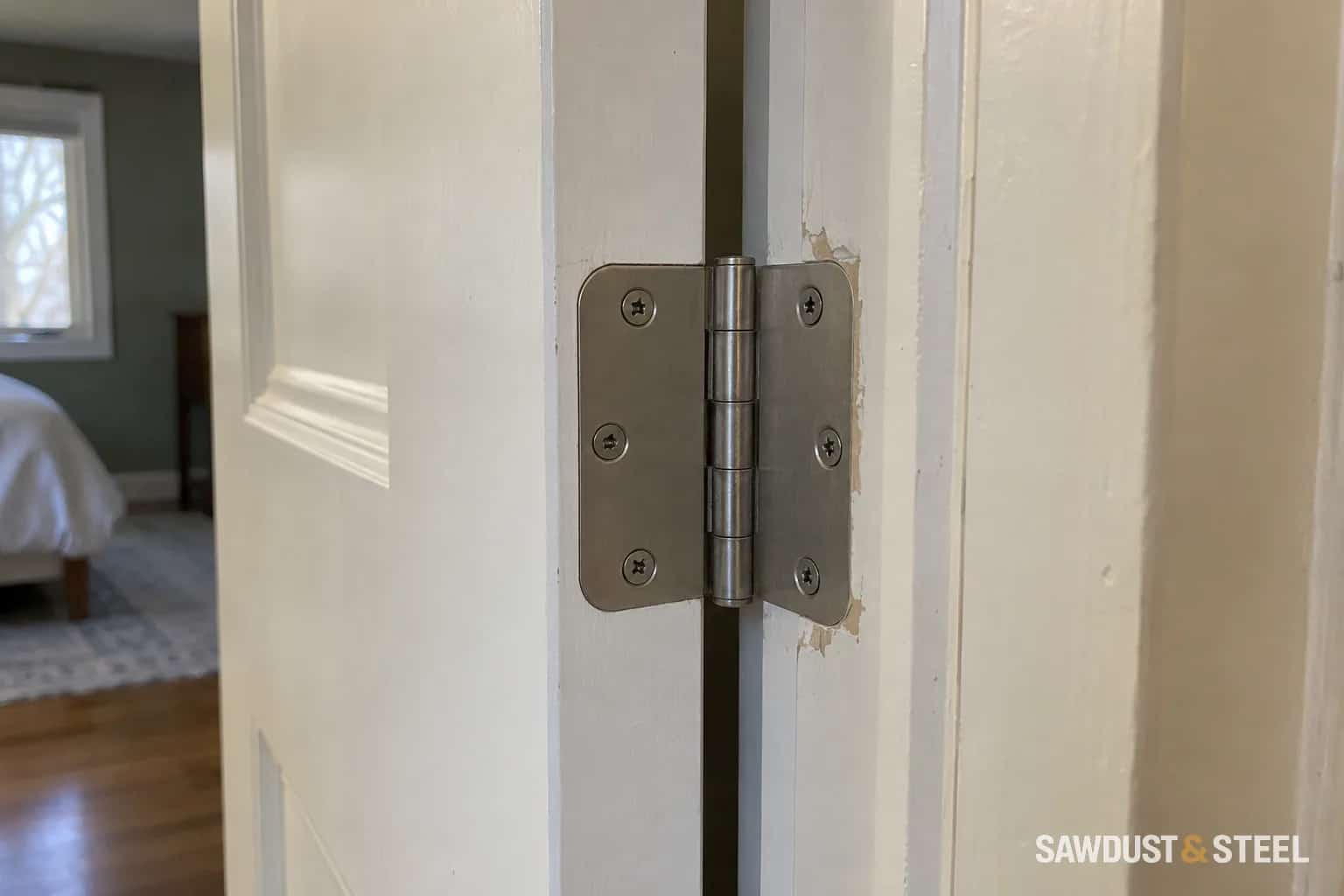
The dark fan of dust below a hinge is easy to wipe off and easy to ignore. When it returns beside a squeak, check what is happening at the joint before reaching for the spray can. The door's weight, the condition of the bearing and the way the hinge is attached all matter.
Watch the hinge while the door moves
Open and close the door slowly without lifting or forcing it. Look for a hinge leaf moving against the frame, a screw head shifting, uneven gaps or metal rubbing at the knuckle. Keep fingers out of the joint. Photograph the dust before cleaning it so you can show where it collects and compare whether it returns.
| What you see | What to investigate |
|---|---|
| Leaf shifts against the jamb | Attachment or damaged screw holes, rather than lubricant alone |
| Door drops or changes position as it moves | Bearing wear, attachment and alignment |
| Stable hinge squeaks without obvious looseness | The model's lubrication or maintenance instructions |
| Dust returns quickly after cleaning | Continuing wear or an unresolved load/alignment problem |
These observations narrow the inspection; they do not prove which internal bearing has failed. A screw that turns without tightening belongs in the stripped hinge-hole repair guide. Repeatedly tightening a screw into an enlarged hole will not restore its grip.
The right lubricant may be no lubricant
ASSA ABLOY's hinge maintenance guidance identifies black dust as a sign associated with bearing wear and calls for attention to fastening, function and lubrication needs. Its instructions differ between hinge constructions. That is the useful lesson: a product family can contain several maintenance methods, not one universal oiling routine.
SIMONSWERK's fitting guidance provides the counterexample. Its maintenance-free, self-lubricating slide-bearing designs must not receive added oil or grease; the manufacturer warns that this can impair the bearing and cause noise. Advice for a conventional metal butt hinge should not be transferred to one of those designs.
Look for branding, a model reference on the hinge or the original door schedule. Concealed, adjustable and spring hinges especially deserve identification before pins, caps or adjustment screws are disturbed. Send clear photographs to the supplier if the model is uncertain. A removable-looking pin is not an invitation to dismantle a loaded door.
Lubrication cannot repair a worn joint or crooked frame
Where the maker specifies lubrication, use its product type, location and amount, protect adjacent finishes and remove the excess as directed. More lubricant is not better housekeeping: it can carry dirt onto the paint and floor. If the hinge has visible play or damaged parts, ask whether the bearing is serviceable or the hinge needs replacement.
Replacement needs to suit the door's weight, size, opening direction and existing hinge preparation. A heavy solid-core slab can demand different hardware from the lightweight door it replaced. Keep any fire-rated assembly's listed hardware requirements in the decision. If the frame is distorted or the hinges are misaligned, replacing one noisy hinge may leave the load problem in place.
Check the whole opening after the dust is gone
A successful repair leaves the door supported, the leaves secure and the swing smooth. Check the latch without pulling the handle upward to help it catch. Take another look after normal use rather than accepting a quiet first swing as the entire test.
A sticky release at the frame may instead be paint bonding to the door stop. If the handle rocks while the hinges stay still, use the loose lever and rose checks. Treating those separately saves a surprising amount of unnecessary oil.