
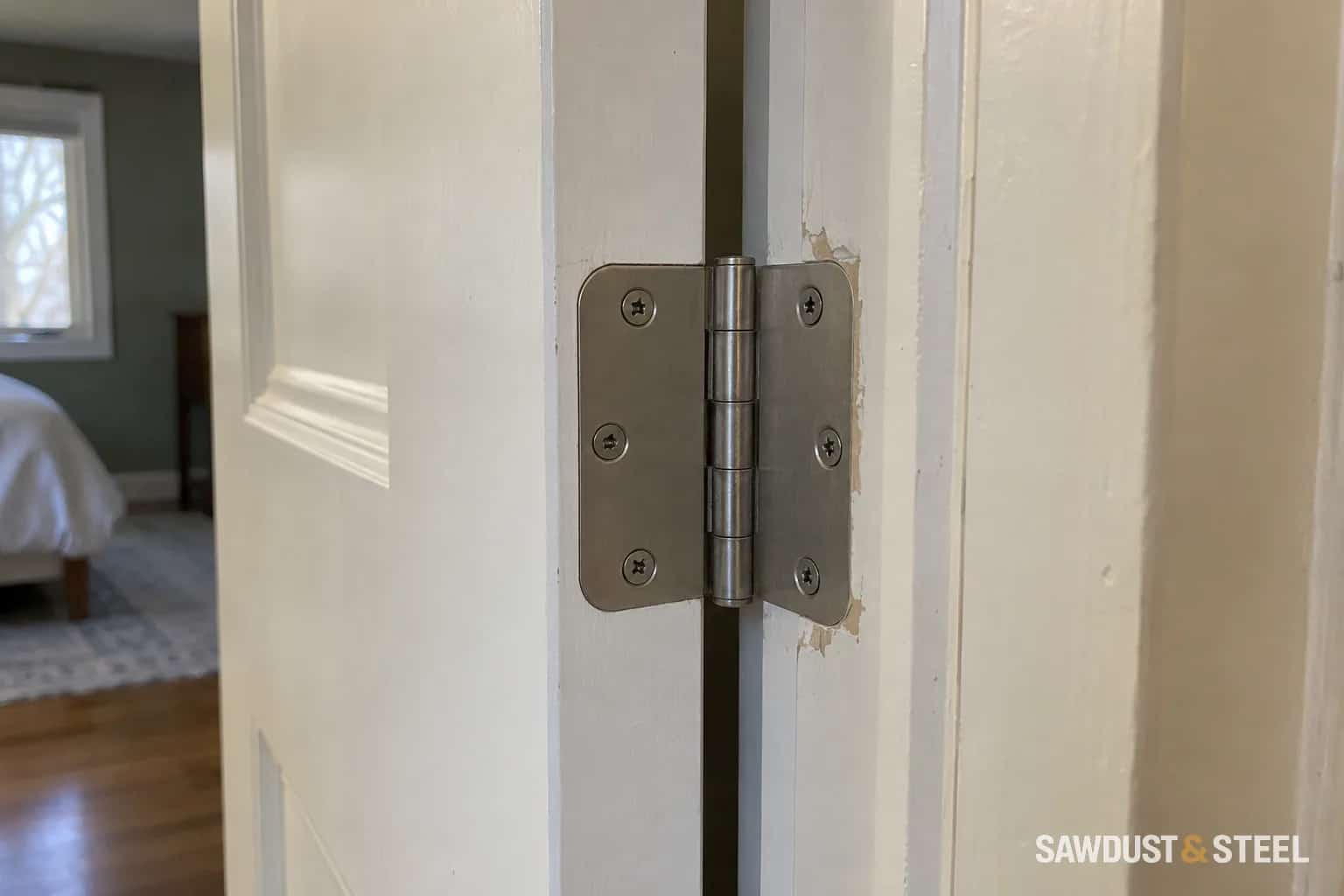
Open the door slowly and watch everything that moves
The lever, knob, towel hook or robe hanger may hit first. A longer replacement handle can change the collision point even when the door itself has not moved. Open slowly with someone watching the wall and adjacent furniture. Mark the desired stopping position with tape, leaving enough margin that a compressed rubber bumper does not let the handle touch.
Look at both sides of the stop's proposed contact. A hollow-core door face can be dented by a small hard pad. Thin drywall can be damaged behind a poorly anchored wall bumper. A stop should spread or transfer the force through suitable material; moving the impact to a weaker surface is not much of a repair.
Choose the mount around the opening
Hinge-pin stop
Into the hinge area and its contact pads; check hinge compatibility and door-face support.
Baseboard or wall stop
Into its fixing and the door contact point; confirm solid backing.
Floor stop
Into the floor assembly; check concealed services and walking clearance.
Hold-open device
Also retains the door; decide whether that behaviour is suitable for the room.
Schlage specifies removable-pin hinges for its hinge-pin stop and lists the hinge-pin sizes it accepts Schlage: Hinge pin door stop.
That makes a hinge-pin stop an option for some openings, not every hinge. Do not force out a fixed or security pin. Check whether the pads land flat as the door opens, rather than dragging across paint or pressing into a raised moulding. A heavy door deserves particular attention to the hardware manufacturer's suitability guidance.
Try the contact point before making a hole
For a wall or skirting-mounted stop, test the proposed length against the door's actual path. A long stop in the wrong place can catch an edge and slide past it. Check that the mounting surface is secure and that the screw will enter appropriate backing. If there may be wiring, plumbing or underfloor heating behind a fixing location, establish a safe position before drilling.
A floor stop can work where the wall offers no sensible target, but avoid creating a toe-catching obstacle in a narrow route. Check cleaning access and whether a nearby door will strike it. Magnetic hold-open fittings add another behaviour: the door remains open until deliberately pulled away. Do not use that to defeat a required self-closing function.
A stop should work without a slam
Test gently first, then with an ordinary opening motion. Confirm that the bumper compresses safely, the fixing stays still and the handle remains clear. Inspect the contact area after a few days for a dent or a slipping mark. If the door swings by itself, check the hinge axis rather than making the stop take a repeated unintended impact. If a new slab is heavier, revisit the stop along with the hinges.