
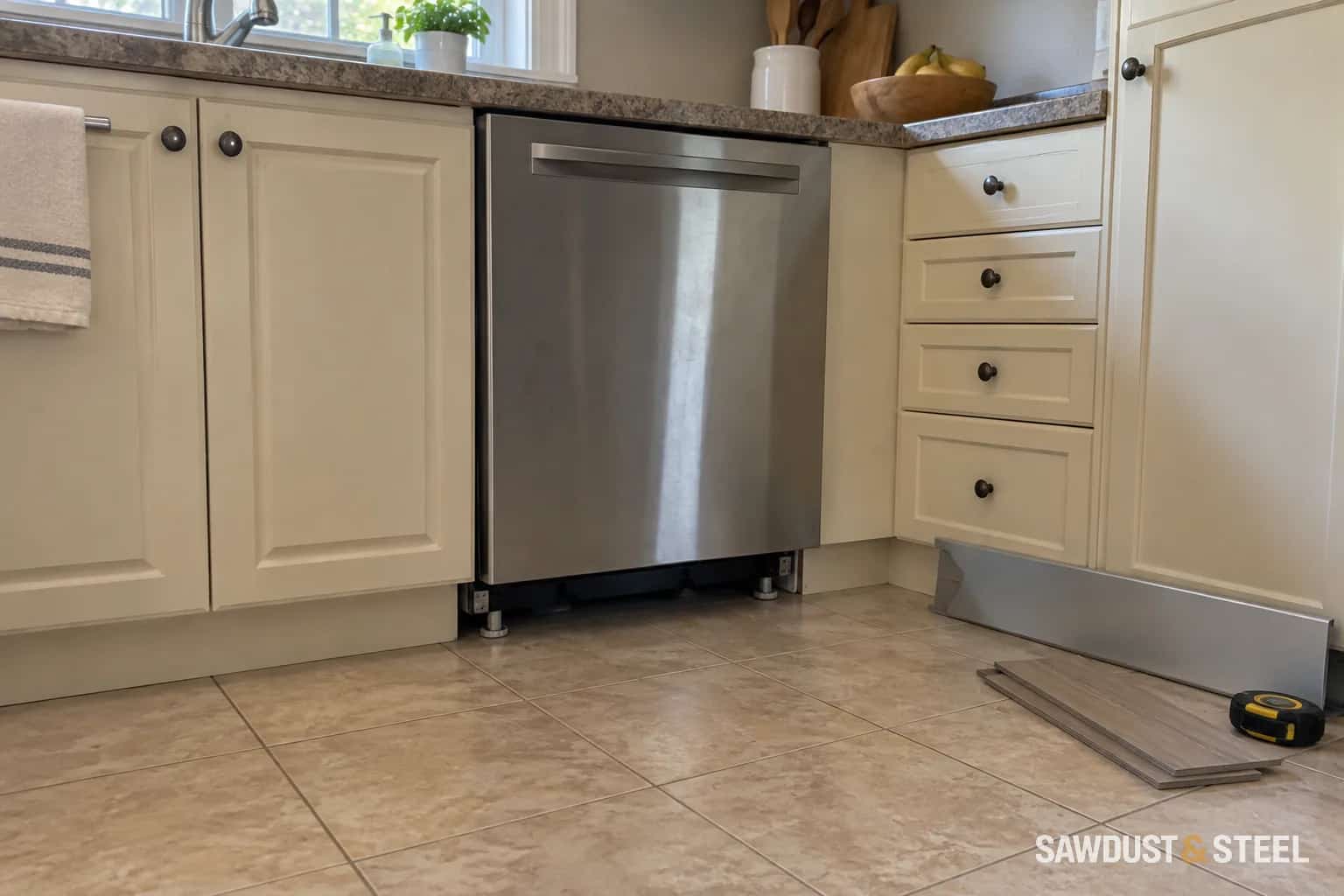
The cabinet shop can make a panel that lines up beautifully with the drawer fronts and still leaves the dishwasher door badly balanced. Panel-ready means designed to accept a specified panel, not any slab of material that happens to match the kitchen.
Give both trades the same appliance documents
Put the full model number, installation template and panel requirements on the cabinet order. Confirm whether the handle weight is included in the maker's limit, whether decorative rails or applied mouldings add thickness, and where fasteners can safely go. An old panel should be checked against the replacement machine rather than assumed reusable.
Bosch: SHV88PZ63N custom panel planning sheet gives a useful model-specific example: the SHV88PZ63N accepts a panel range wider than its factory-ready weight band and directs owners outside that band to customer service. The numbers belong to that model. The useful lesson is to distinguish the permitted finished panel from the starting hinge setup.
Finished mass
Count the complete installed front as the appliance maker defines it.
Thickness and screws
Use the prescribed template and fastener penetration.
Bottom swing
Trace the panel past the plinth or toe-kick.
Neighbouring fronts
Check handles, side gaps and the fully open door.
The bottom edge needs somewhere to go
As the dishwasher opens, its panel may swing back towards the toe-kick. A sliding-hinge system and a fixed-panel system do not move alike. A taller panel chosen to align with adjacent cabinets can collide even when the appliance itself fits the opening. Have the installer verify the manufacturer drawing against the actual floor and toe-kick position.
Do not trim the toe-kick blindly or remove an appliance ventilation part for a tidier reveal. If the required front cannot meet the desired cabinet line, resolve that during design with a compatible model, panel height or approved installation option.
A dropping door is a commissioning problem
Keep clear of a door that falls unexpectedly, and do not let children use it as a step. Ask the installer to verify the finished panel weight, spring or hinge setup and anchoring. A machine that moves with the door needs the anchoring check too. One correction does not prove the other is right.
Before sign-off, open and close the door through its full range, check the panel against the toe-kick and neighbouring pulls, and confirm that future removal does not require destroying cabinetry. Matching the finish is the enjoyable part; keeping the approved template and model details makes the next repair much easier.