
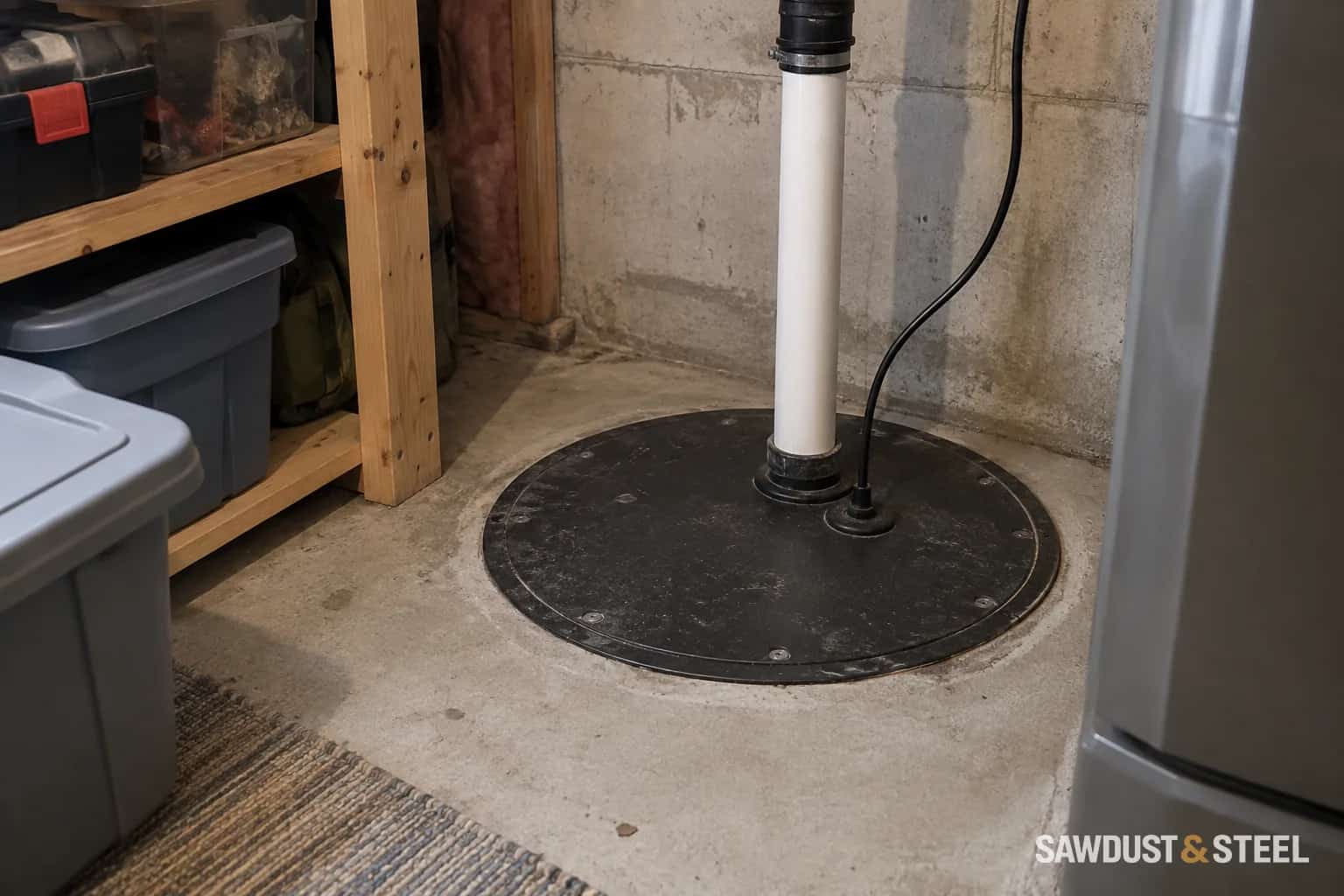
Before we framed a basement storage wall in Oakville, the owner pointed to the sump and asked whether we could make it disappear. Visually, yes. Operationally, that would be a poor afternoon's work. The pump was the one thing in that corner we wanted someone to find quickly.
A cover has more than one job
It can limit an opening between the soil below the house and the indoor air. It also has to coexist with the discharge pipe, electrical cord and whatever inspection or service the equipment requires. A board laid over the hole is not the same as a purpose-made sealed arrangement.
Health Canada's radon reduction guide describes airtight sump covers as one way to address an entry route. It also explains that sealing openings alone is not a dependable standalone radon-reduction method. If the sump receives floor drainage, that function needs an appropriate detail too.
Plan the next pump replacement now
- Confirm what enters the basin and how water is supposed to reach it.
- Choose a cover arrangement that can be opened and resealed for service.
- Coordinate sealed pipe and cord penetrations without pinching cables or restricting the pump mechanism.
- Leave enough surrounding and overhead access for inspection and pump removal.
A tiny door that lets you see the lid is not necessarily enough. Picture the actual pump coming out, with someone working beside it. Shelves, partitions and heavy stored items should not turn routine service into demolition.
Have the sump installer and radon professional coordinate the detail where both systems are involved. A suction connection for radon is not something to add by guessing which pipe should go where.
Testing tells you what the seal cannot
You cannot judge radon by the smell of the basement or the neatness of a bead of sealant. Use the radon testing plan before enclosing the space, and follow the measurement guidance for the finished mitigation. A fitted lid is a completed construction detail, not a passing radon result.
If the pump is already cycling unusually often, resolve that issue as part of the planning. The lid should not make an existing operating problem harder to investigate.
The cabinet got a little smaller
In Oakville, we shortened the proposed storage run and made the access obvious when the door opened. The owner lost a narrow shelf. He kept a useful way to service the equipment that protected everything on the other shelves. It was an easy trade once we drew the pump coming out.
Keep the cover information with the pump manual, and include access when considering battery backup. After service, the seal needs to be restored as intended; removable should not become permanently left loose.