
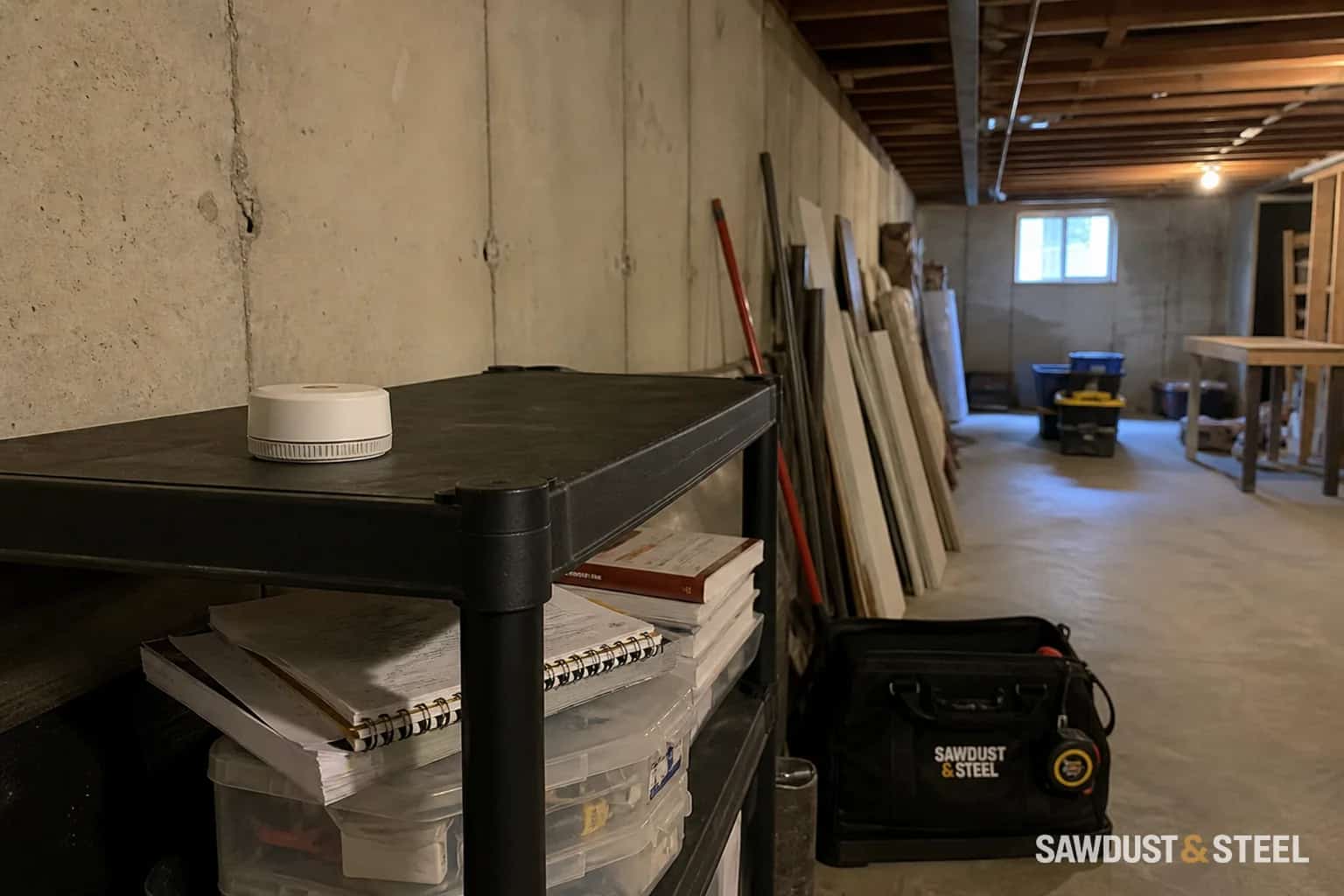
Yes, test before finishing the basement. Radon is invisible and odourless, levels can differ between neighbouring homes, and testing is the only way to know the level in your house. A renovation is the useful moment to learn whether the plan also needs radon mitigation space or details.
Why test before the basement is finished?
Health Canada's 2026 guide for radon measurements in homes specifically treats a basement that will soon become a bedroom or office as a potential normally occupied area. Testing early gives the designer a result before the slab, walls, mechanical room, and future room use are locked in.
For a planned basement office, we put the test location on the room sketch before the storage shelves moved. The owner had meant to leave the detector beside the sump because that looked like the likely entry point. We used Health Canada's placement guidance to select a spot representative of the future occupied space instead. The start date and location went into the project notes so the device would not get boxed up during clearing. Keep that baseline report and plan follow-up testing: changes to air sealing, ventilation, heating, foundation openings or a mitigation system can change the result.
How long should a radon test run?
Health Canada recommends a long-term test lasting 3 to 12 months, with at least 91 days during the heating season. The longer test better estimates the annual average. A few unusually high readings on a new electronic monitor can be informative, but a short test is not the recommended basis for a mitigation decision.
Where should I put the radon detector?
| Location | Use it? | Reason |
|---|---|---|
| Lowest lived-in bedroom, office, den, or family room | Yes | Represents a normally occupied area |
| Future basement bedroom or office | Yes | Health Canada includes spaces that may soon be occupied |
| Bathroom, laundry room, kitchen, or storage room | No | Humidity and ventilation make these poor test locations |
| Beside a sump, crack, window, vent, or exterior wall | No | The reading may not represent the normal breathing zone |
Place the approved device off the floor in the breathing zone, with normal airflow around it and away from sunlight, heat, windows, doors, fans, vents, exterior walls, and powered electronics. Follow the device instructions and live normally during the test. Do not tune the house for test day; the point is to measure the house you inhabit.
What does the radon number mean?
The current Canadian radon guideline recommends corrective action when the average annual level exceeds 200 Bq/m³ in a normally occupied area. Health Canada says to act sooner when the level is higher and to reduce it as much as practicable, rather than treating 200 as a target to land on.
Can the basement renovation reduce radon?
A renovation can make room for mitigation work, but ordinary insulation or cosmetic crack filling is not a verified radon solution. If the long-term result is high, use a C-NRPP-certified radon professional to assess and mitigate the house, then test again to confirm the result. Coordinate any slab penetrations, sump covers, piping, fan location, electrical supply, and discharge route before finishes close the area.
Radon planning belongs beside moisture and insulation planning. Read the Ontario basement insulation guide and resolve active water using the basement waterproofing guide. One concern does not cancel the other.
What should I do today?
- Choose a C-NRPP-approved long-term detector.
- Put it in the lowest room that is, or soon will be, occupied for more than four hours a day.
- Record the location and start date, then leave the device undisturbed for 3 to 12 months.
- Make sure at least 91 days fall within heating season.
- Give the result to the renovation designer before finalizing the basement assembly and mechanical layout.
Where a sump is part of the plan, coordinate an airtight lid with pump access and drainage. A neat seal does not replace a measured radon result.