
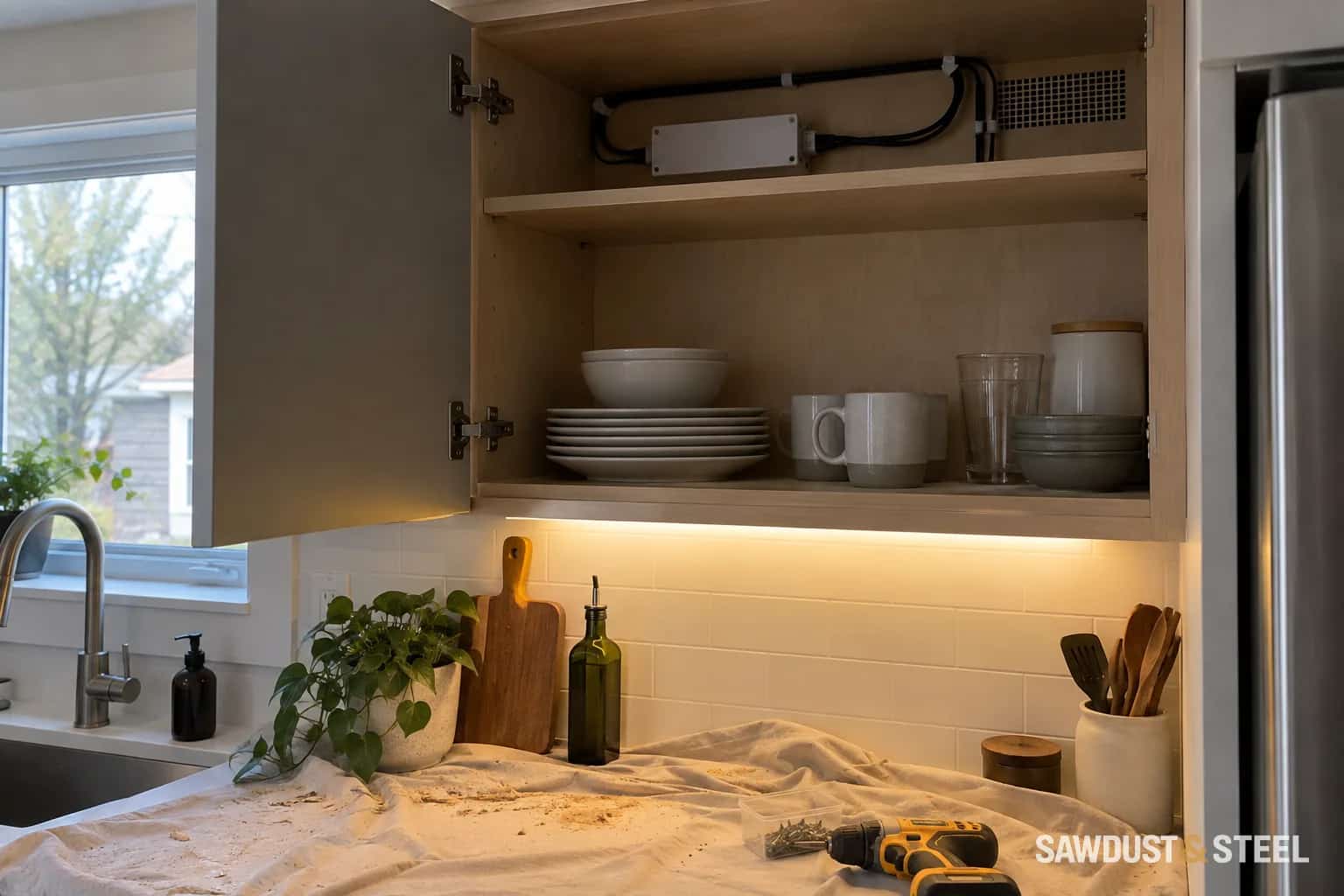
The kitchen lights had lasted longer than the owners could remember. When one run stopped working, they could find the light strip but not the little box powering it. It was eventually located behind fixed trim above a wall cabinet. The trim had been painted beautifully. Several times.
The driver belongs on the kitchen plan
Many low-voltage LED systems use a driver or power supply to provide the electricity their lights need. Some fixtures package it differently, so identify the actual system rather than assuming every strip has the same box. Its position matters to the cabinet maker as well as the electrician.
Armacost Lighting's driver-selection guide explains the need to match voltage, load, dimming and environment, and warns against poor ventilation. Use the selected system's installation instructions for the final arrangement. A power supply with a similar-looking plug is not automatically a replacement.
Access means being able to replace it
- Mark the driver location on the cabinet drawing before fabrication.
- Show how its cover, plugs and fastenings can be reached after installation.
- Preserve the specified ventilation space and keep stored items out of it.
- Record the driver, light and control model numbers together.
A removable service panel can be useful when the system and electrical arrangement allow it. Permanently glued crown or a tiled-over opening is a different proposition. Ask the installer to show the replacement route before the final trim is fastened.
Do not treat a low-voltage light strip as proof that everything behind it is safe to handle. The driver's supply side may be mains voltage. Have hardwired work and any required electrical notification handled appropriately.
Leave room for the next change
Keep connectors and labels accessible rather than burying them in an anonymous bundle. Note which switch or dimmer operates each run. A useful handover photograph shows the closed location and the open service space, with the equipment identification readable in the private project records.
Avoid packing the service compartment with tea tins later. We know exactly how an empty kitchen space becomes storage. If it needs to stay clear, make that purpose obvious during handover.
A better hiding place
On the replacement job, the new arrangement used an accessible location agreed with the electrician, and the repaired trim no longer had to be removed for service. The owner described this as making the next failure less annoying. That is a perfectly respectable design goal.
If you are planning new lighting, settle countertop glare and light-strip position as well as the hidden equipment. Coordinate the cable route with backsplash outlets before tile arrives.
A kitchen light should make it easier to chop an onion. Replacing its power supply should not require undoing half the room.