
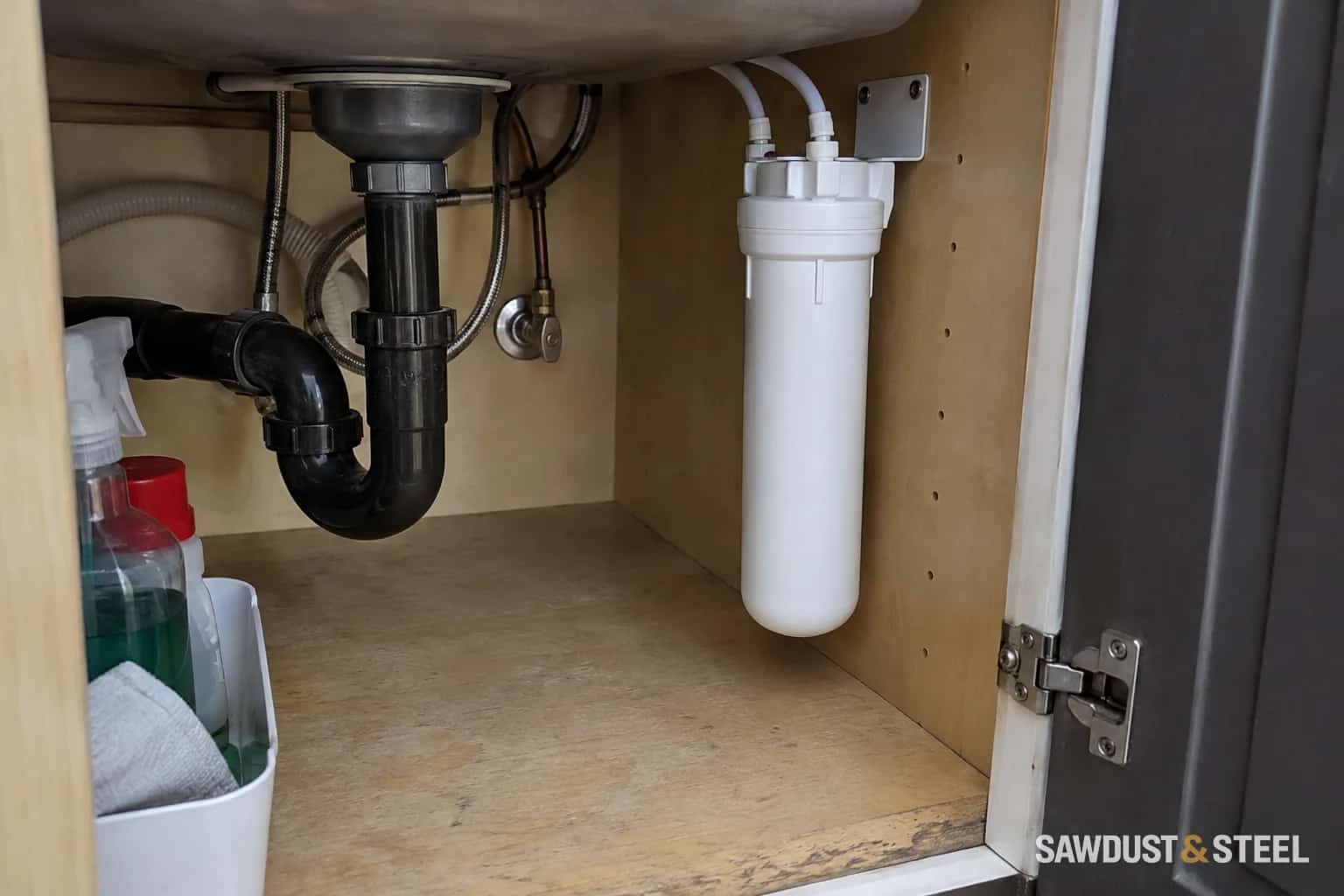
The cartridge change should not require removing the recycling system, undoing a plumbing joint and finding the one short screwdriver in the house. Plan that future job while the sink cabinet is empty. The filter's outline on the box is only part of the space it needs.
Separate installed space from service space
Identify how the cartridge or housing comes off. It may lower, twist, swing or pull away from a head. Include the space to grip it, use any specified wrench and support a water-filled housing. Check the removal route through the cabinet opening, not just the gap between the filter and floor.
For example, the Aquasana AQ-MF-1 instructions call for three inches beyond the cartridge base for replacement and show approved horizontal and vertical arrangements. The Pentair US-1500 instructions specify a different below-system clearance. Use the manual for the model being installed; these examples are not a shared minimum.
Mark the installed body in one colour on a sketch and the space needed to remove it in another. Neither area should be filled by a permanent shelf, drawer runner or plumbing alteration. The second colour is easy to forget because it looks empty for most of the year.
Make the competing movements visible
| Part of the cabinet | Check with the filter in place |
|---|---|
| Pull-down faucet | Full hose and weight movement without catching tubing or the housing. |
| Waste pull-out | Closed position, full extension and lifting the bins out. |
| Water shutoffs | Hand access without first removing the filter or a fixed shelf. |
| Sink waste and trap | Space for existing connections and future maintenance. |
| Filter cartridge | Removal direction, grip/tool room and route out through the door. |
| Door and hinges | Clear opening at the height where the housing passes. |
Use a cardboard cylinder or box matching the filter, then move a second piece along its withdrawal direction. Put the real bins back, run the faucet hose through its normal travel and open both cabinet doors. An empty cupboard photographed from the front can hide a conflict that takes seconds to reveal this way.
Choose a supported position, not the last empty patch
The mounting surface must support the complete operating assembly using the product's specified fixings. A thin cabinet back or a door panel may not be suitable. Do not assume a housing can lie on its side because that makes it fit; orientation depends on the product. The cited Aquasana unit permits specific alternatives, while other systems require a particular mounting direction.
Keep the upstream isolation accessible and identify it for the person who will change the filter. Follow the system's pressure-release and cartridge-change procedure when servicing. Do not disconnect a pressurised housing just because you can reach it. Where plumbing alterations are needed, have the installer establish the connection and support arrangement.
Tubing also needs a protected route that does not kink, rub against moving hardware or pull tight when a component is serviced. Avoid bundling it around the faucet weight. Our pull-down hose guide helps identify that particular conflict before it becomes an everyday annoyance.
A different treatment system can change the entire plan
Replacing one cartridge filter with another is not necessarily a like-for-like space change. A reverse-osmosis system may add a storage tank, drain connection, extra cartridges or electrical needs, depending on the model. A separate drinking-water faucet also needs an approved place in the sink or counter. Settle those requirements before drilling or ordering stone.
This is a layout decision, separate from choosing treatment for your water. Obtain the system appropriate to the water-quality problem, then plan around its actual installation and maintenance requirements. A smaller housing is not automatically an equivalent treatment system.
Do a service rehearsal before the cabinet is signed off
Ask the installer to demonstrate isolation and explain the cartridge removal sequence. Keep the manual, replacement part identification and change record where they can be found. Confirm that normal storage can be removed easily without tools and that no new organizer occupies the reserved service space.
Planning another water-fed appliance nearby? An undercounter ice maker may also need a drain or approved pump. Resolve those services before using the remaining cupboard space for either system.
If you are also adding pull-out shelves, size them around the filter's working envelope, not only its body. When a future cartridge change exposes moisture or damaged board, inspect the cause before putting everything back; the under-sink water guide separates several likely leak sources.