
A phone notification is useful when someone can act on it. It is less impressive when you are three hours away and the water is still running into the vanity. Start by deciding whether you need warning, automatic action, or both.
Separate finding water from controlling it
Moen's system overview distinguishes an inline supply monitor from point detectors placed near vulnerable fixtures. The inline device observes the water supply; the separate sensor detects water reaching its location. A point sensor cannot tell you about a leak that never reaches it, and an inline monitor does not necessarily identify the leaking fixture.
Moen's Canadian Flo FAQ confirms that its inline device can flag abnormal use without pinpointing the leak. The same FAQ says detecting a small drip does not automatically mean the water will shut off. Ask what events trigger an alert, what triggers closure and how settings change that response.
| Arrangement | Response to plan |
|---|---|
| Local alarm | Who can hear it, reach the valve and respond? |
| Connected point sensor | What happens if its network or battery fails? |
| Automatic supply shutoff | Which event closes which valve, and how is it reopened safely? |
| Combined system | Which functions work locally, and which depend on internet services? |
Power failure and internet failure are different
For the Flo example, Moen's current Wi-Fi guidance says monitoring can continue locally during a Wi-Fi interruption, while real-time alerts and remote control require internet access. That does not prove every linked point-sensor command will still reach the valve. Confirm that behaviour for the actual devices and configuration.
Moen's power-outage guidance says losing power does not itself close an open Flo valve and describes manual operation during an outage. The INS11955B installation guide requires continuous power and describes local-mode behaviour when unconnected. Have the installer explain any backup provision and demonstrate the exact manual control on your unit. Do not rely on an app as the only way to turn the water off.
Place detectors where the water will reach them
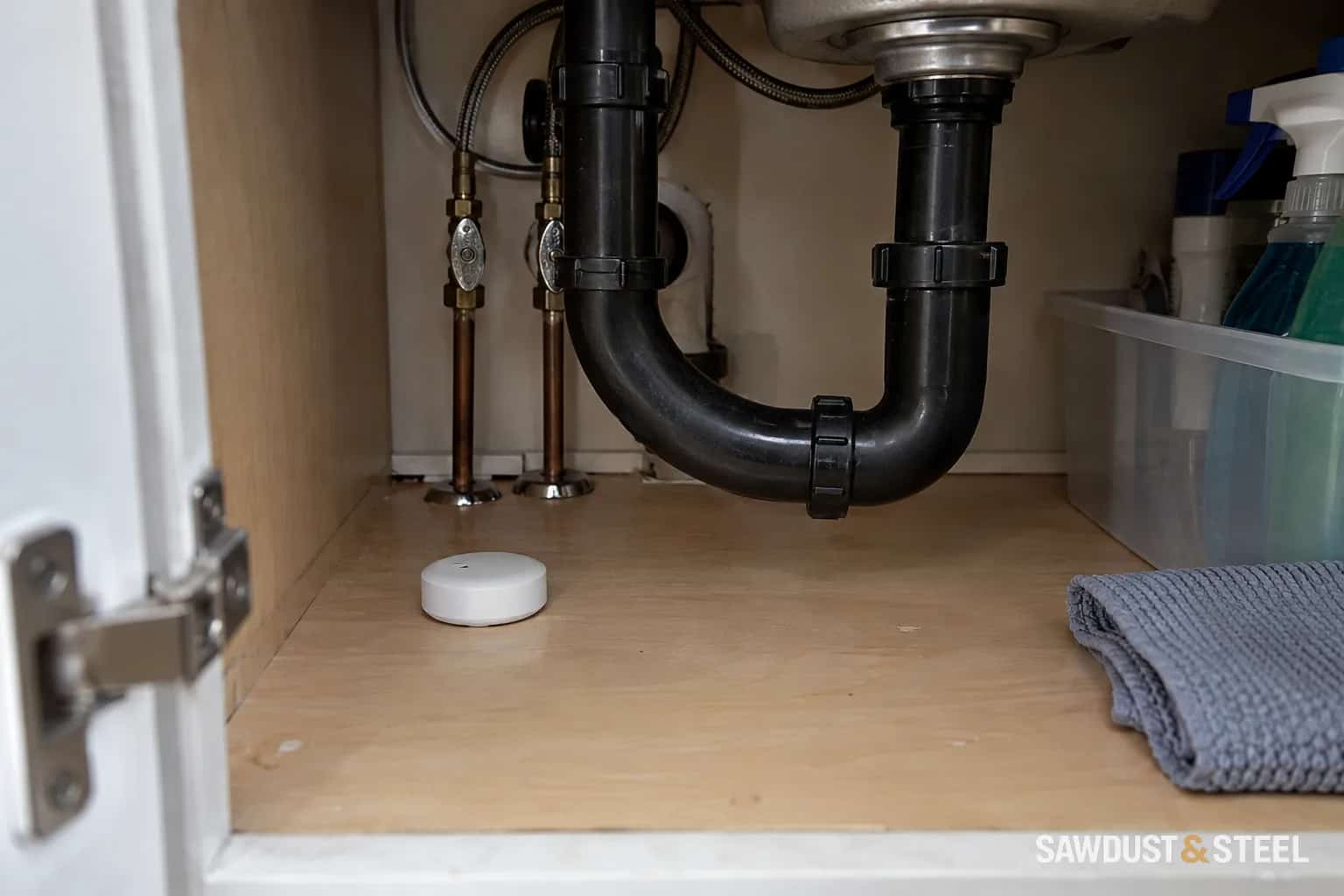
Map the likely leak points: supply connections, sink cabinets, appliances and the water heater. Follow the sensor's placement instructions and check the actual low point. A sensor balanced on a shelf above the pipe may stay perfectly dry while the cabinet floor fills.
Keep the detector reachable for testing and battery changes. Agree who receives alerts, who has access when you are away and what they should do. If someone has limited hearing, vision or reach, select and test an alert and manual response they can actually use. Do not create a flood to test the system; use the manufacturer's test method.
Keep plumbing access and a manual fallback
Have a plumbing professional confirm the installation location, compatible pipework and what branches the device controls. Fire protection or shared-building supplies require explicit specialist coordination. Retain access to the manual main shutoff and any device tool, and label the arrangement clearly. In a condo, confirm ownership and permission before altering a shared or unit supply.
Closing the supply cannot stop groundwater coming through the foundation, sewer backup or water already stored downstream. Existing backwater-valve access serves a different purpose. If water is already under the sink, follow the leak investigation guide rather than buying monitoring as a repair.
At handover, record the model, settings, test procedure and who maintains it. Include a safe procedure for checking an alert before reopening the water. For a main-floor living conversion, reachable valves and a clear response plan can be as useful as the newest connected device.