
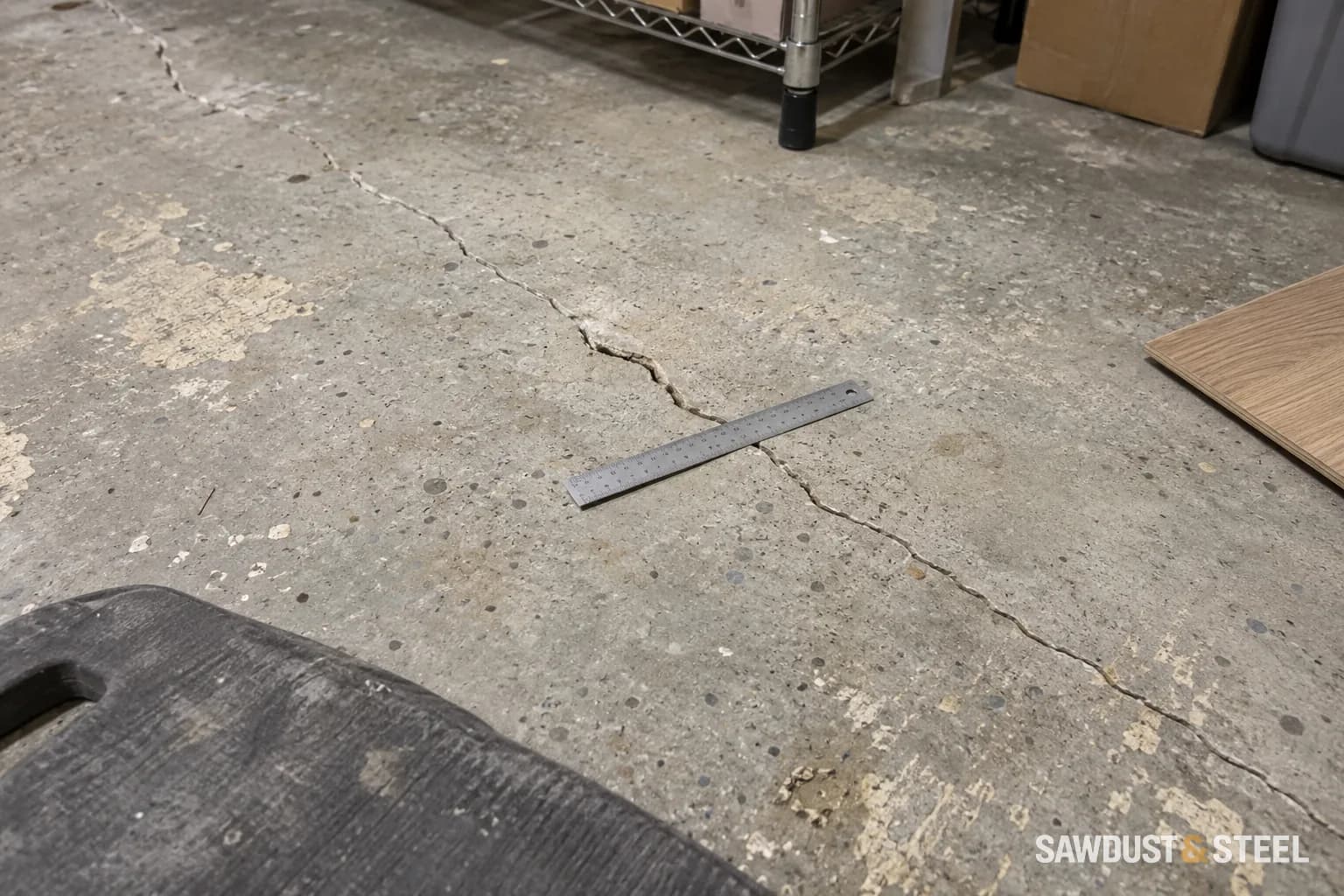
The box says waterproof. The basement smells damp. Both observations can be true at the same time.
Ask what the claim actually covers
Read the specific warranty and installation instructions. Establish what they say about substrate moisture, underlay, below-grade use, and water beneath the installation. The word on the box is not a complete description of the floor assembly.
Health Canada's moisture guide emphasizes addressing the moisture source. A surface that tolerates a spill does not establish that concealed dampness has been corrected.
Investigate before covering the evidence
For a concrete example, TORLYS' RigidTile FIRM Premier instructions call the product waterproof while excluding abnormal conditions including water trapped beneath it. The document also specifies a concrete moisture test and substrate limits. Those are requirements for that product, not universal limits for every vinyl floor.
- Ask for the exact flooring manual and the required test method, with its units and pass/fail limit.
- Keep the test date, locations and results, together with the room conditions and any required moisture-control work.
- Confirm the subfloor, underlay and adhesive or floating arrangement are approved together.
- Recheck what happens to drains, access covers and the bottom stair after all layers are added.
A room humidity reading is not the same measurement as an in-slab moisture test. Have the installer name the required test before accepting a number as proof that the slab is ready.
Record when the dampness appears and whether it follows rain, humid weather, or plumbing use. Have visible water entry and suspect materials assessed. Ask the flooring installer which substrate tests and preparation their chosen product requires.
Compare carpet, removable rugs and a compatible vinyl assembly
| Finish | Practical benefit | Moisture consequence |
|---|---|---|
| Wall-to-wall carpet and underpad | Soft, quiet surface across the room | Can conceal dampness; affected porous material may need removal |
| Suitable hard floor with removable rug | Softness where people sit; rug can be lifted | Rug and floor underneath still need inspection; keep removal possible |
| Approved below-grade vinyl assembly | Spill-resistant surface when installed to its instructions | Water below the surface and substrate limits still matter |
| Leave the slab exposed while investigating | Keeps changing conditions visible | A temporary planning choice, not a moisture repair |
For a playroom, draw the rug first and keep its edges out from under fixed storage. Imagine carrying it out after a spill without removing a wall of bookcases. Elena's Mississauga layout used a smaller rug where the children sat and a washable play surface near the toy bins. The room kept its soft landing spots while the perimeter remained inspectable. That is a layout benefit, not a promise that any rug backing suits any vinyl finish.
Check the flooring manufacturer's rug-backing and cleaning instructions before choosing a mat. A removable covering is useful only if someone actually lifts it. Include its underside and the surrounding floor in routine checks, particularly after a leak or musty smell. Where water has entered beneath the floor, surface drying alone does not establish that the assembly is dry or clean; have the affected layers assessed and follow the applicable removal, drying and replacement guidance.
A worked moisture acceptance example
The TORLYS RigidTile FIRM Premier manual, revision 4 August 2020 as currently hosted, specifies concrete at no more than 80% relative humidity measured with an in-situ probe under ASTM F2170. This is a product-specific example, not a limit for every vinyl plank. The document also calls for a clean, firm, flat, smooth and dry substrate. Ask the supplier to confirm the current instructions and below-grade suitability for the exact product you buy.
Suppose the specified tests return 74%, 77% and 83%. The 83% result exceeds that example product's limit; averaging the numbers to make the room look acceptable is not the stated acceptance test. Keep installation on hold while the installer and supplier resolve the condition and approved next steps. A room-air hygrometer reading of 45% cannot replace those in-slab results.
Include the floor-crack assessment and bottom-stair height in the same decision. Comfort matters, but the floor should not conceal an unresolved slab or make the last step awkward.
Keep the assembly compatible
TORLYS' floating-floor guidance illustrates why movement and fixed loads matter to an installation. Follow the actual product's rules for walls, cabinetry, transitions, and expansion; do not apply a laminate document as vinyl instructions.
- Confirm the flooring is approved for the intended below-grade application.
- Use the specified substrate preparation and moisture-control approach.
- Keep required movement space around fixed objects.
- Preserve access to floor services and maintenance covers.
Keep the flooring order flexible until the dampness and product requirements are understood. If you're wondering whether opening the windows will help, start with why summer air can make a basement wetter. It helps separate an airing habit from the water problem a new floor can't fix.