
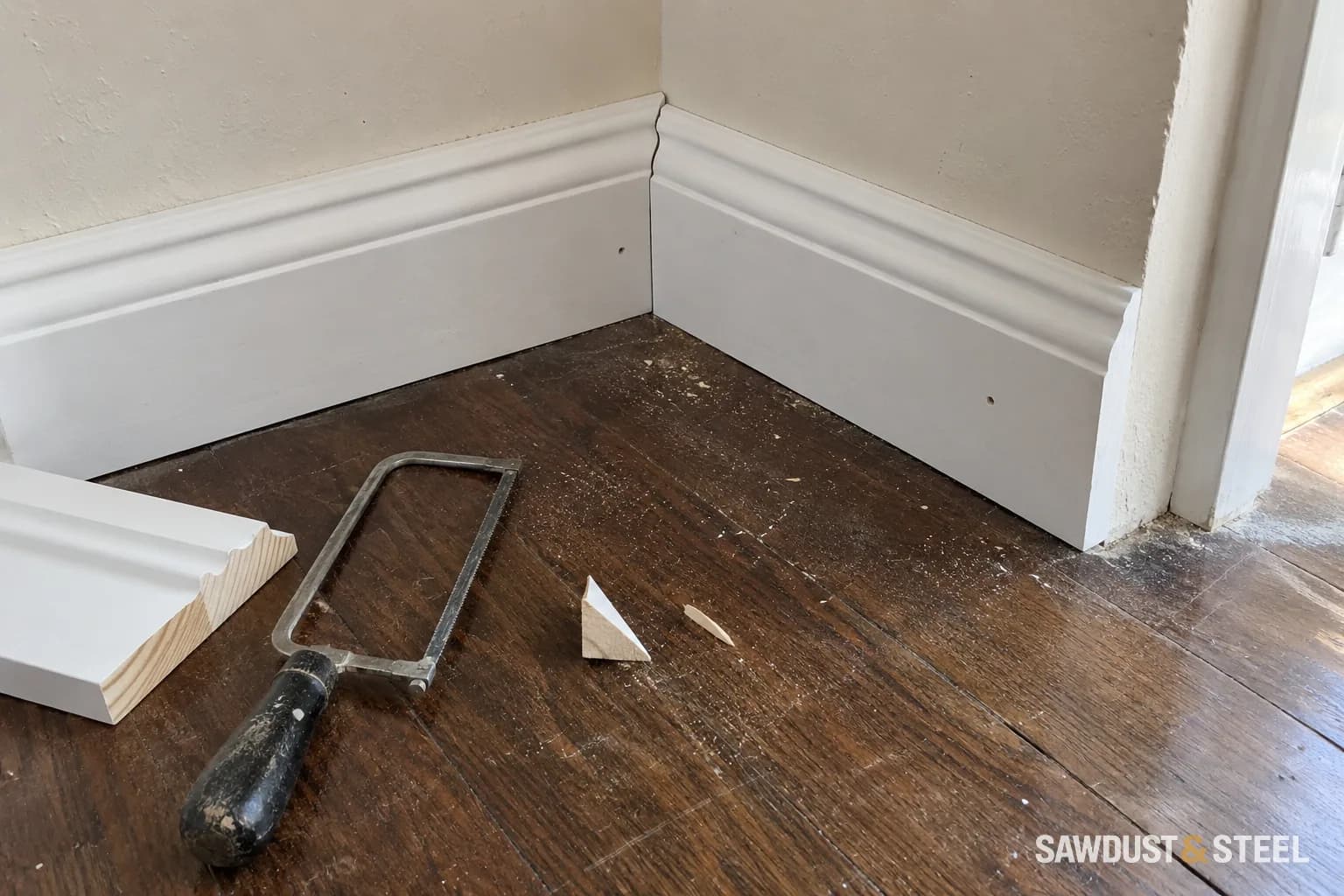
Two neat cuts meet in the corner, almost. The small triangular gap waits for someone to call it a painting problem. It usually deserved a little more attention before the paint arrived.
Understand what the two joints are doing
The Home Depot's baseboard guide shows coping an inside corner by fitting a shaped end to the adjacent profile. A plain square board and a detailed moulding do not present the same joint. Outside corners require their own treatment.
Coped joint
One square-ended board meets a second cut to fit its face profile.
Mitred joint
Two angled ends meet; fit the cuts to the actual corner.
Outside corner
A projecting corner normally uses fitted mitres.
| Situation | Useful approach | Dry-fit check |
|---|---|---|
| Shaped paint-grade inside corner | Coping often accommodates an imperfect corner neatly | Profile seats without a thick caulk bridge |
| Stained shaped trim | Careful joint fitting and finish sample | No conspicuous filler line or exposed pale cut |
| Plain square stock | A deliberately detailed butt or mitre can be appropriate | Agree which end grain will show |
| Outside corner | Fit the mitres to the actual angle | Faces meet and the top profile continues |
Use scribing checks for an uneven wall when the problem is the wall line rather than the corner cut. A chipped outside point calls for the profile repair guide, not more caulk along the inside joint.
Judge a sample in the actual corner
Ask the carpenter to dry-fit offcuts of the chosen material where the walls meet. Look at the top edge and profile alignment as well as the seam. Paint-grade and clear-finished trim allow different finishing options, but neither benefits from an unnecessarily large gap. Seasonal movement also makes a promise of permanently invisible joints unrealistic.
For a separate frame or cabinet assembly, rehearse the whole clamp sequence too. The dry-fit guide covers part orientation, clamp access and working time before adhesive goes on.
Before the next step
- Choose the actual profile and material before agreeing on the joint.
- Review a dry-fit sample in an imperfect corner.
- Keep finishing expectations appropriate to paint or clear finish.
A tidy corner is a small pleasure that repeats around the room. It is worth fitting the pieces to each other before asking filler to introduce them. Check the dry fit from both directions down the wall. The top edge should line up and the profile should meet without a thick filler line.