We had just finished an Oakville kitchen where the old gas range became an induction cooktop. The owner loved the flat surface. She also loved the idea of replacing the hood with one very nice shelf. Then her partner mentioned his Friday-night fish. The shelf lost its campaign quite quickly.
The pan still makes things airborne
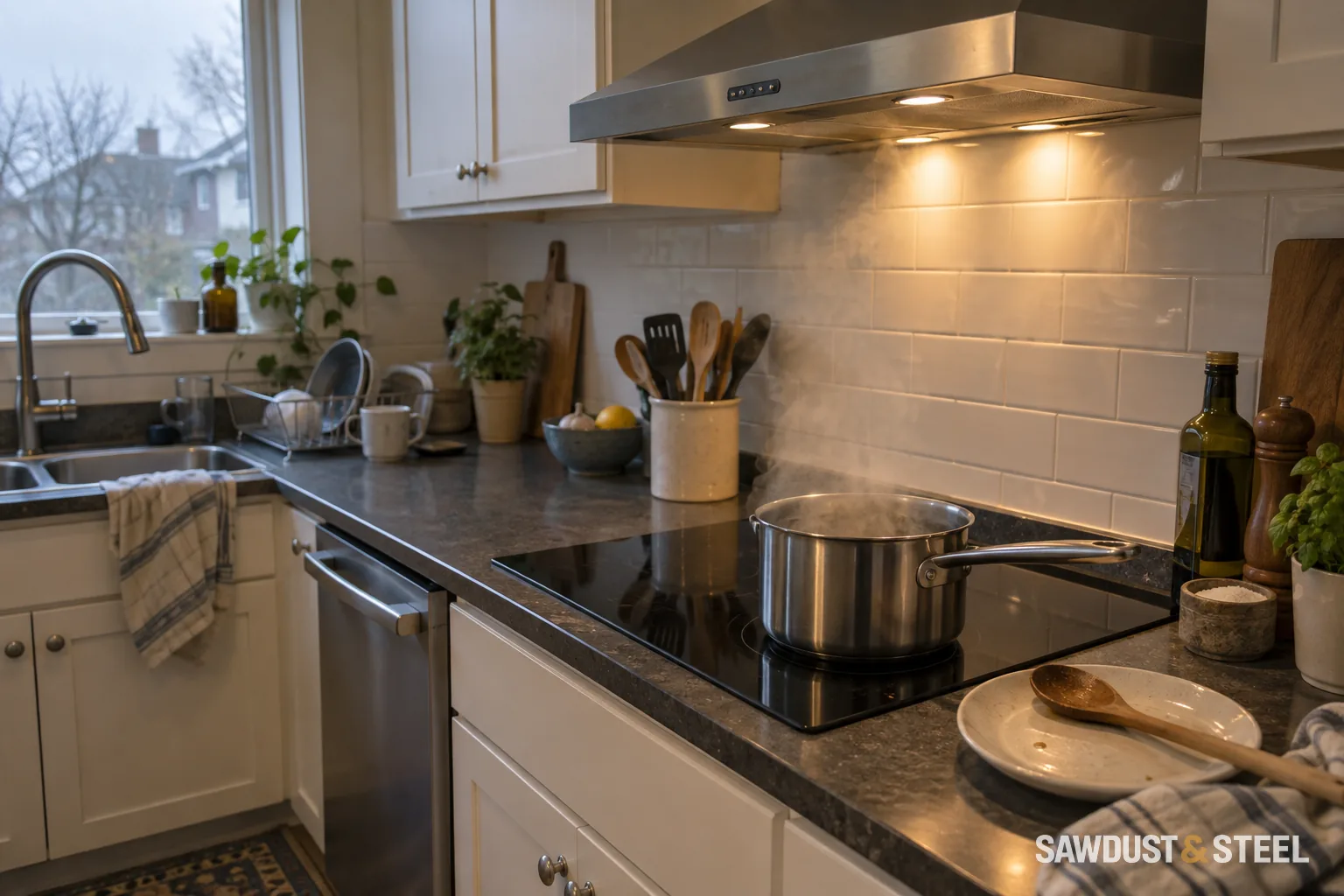
Changing the heat source changes one part of cooking. It does not remove the food and oil sitting above it. Health Canada's cooking and indoor-air factsheet explains that cooking on electric as well as gas appliances creates particles, while cooking activities also add water vapour. A hood can help remove those emissions.
You do not have to burn dinner for ventilation to be useful. Think about the film that eventually appears on cupboards near a busy stove, or the steam from a large pot. The work of the hood has not disappeared just because the new appliance has touch controls.
Ducted and recirculating are different decisions
A ducted hood sends captured air outdoors through a suitable route. A recirculating model filters air and returns it to the room. It should not be treated as equivalent moisture removal. Broan-NuTone explains the difference, including the need for the correct conversion kit and filters where a hood supports non-ducted use.
If a condo or awkward layout limits an outdoor route, establish the available options before designing the cupboards. A ductless product label does not settle building approval, condo permission or the requirements of your specific project.
Make the fan easy to live with
- Choose around the actual cooktop dimensions, cooking habits and available duct route.
- Check the allowed mounting position in both appliance manuals.
- Listen to a working hood if you can. Controls you can reach and a tolerable everyday sound matter.
- Plan access for cleaning the grease filters and replacing any other specified filters.
Our Oakville clients kept a compact ducted hood, with the controls easy to reach. The shelf moved to the coffee corner. That suited everybody, including the fish. A useful renovation often involves giving a good idea a slightly different address.
The electrical change has its own plan
Ventilation is one part of the switch. The electrical planning for induction and any gas disconnection work need the appropriate people too. Do not let a neat appliance swap hide the work behind it.
If the old hood worked well, it may be reusable after compatibility and condition checks. If it struggled, inspect the duct route before assuming a new cooktop will solve that.
Follow the plume from the pan to outdoors
Induction removes combustion at the burner, but frying, browning and boiling still put material into the air. Health Canada's cooking factsheet recommends using a range hood, preferably one that exhausts outdoors, and using the back burners where practical. Switch the hood on as cooking starts rather than waiting for the smoke alarm to comment on dinner.
A recirculating hood filters and returns air to the kitchen. Its filter arrangement does not create an outdoor moisture exhaust path. Check the exact model's filter-care and replacement instructions, and distinguish a quieter setting you will actually use from an impressive maximum that stays switched off.
During planning, stand at the cooking surface with the normal pan and lid. Check canopy coverage and comfortable reach to the controls. Coordinate the hood and replacement-air system with the induction electrical change; solving one does not complete the other.
Induction element
Heats suitable cookware without a gas flame.
Food and pan
Cooking still releases particles, moisture and odours.
Canopy and filter
Capture the rising plume and collect grease as designed.
Ducted outlet
Discharge captured air outdoors through the approved route.