
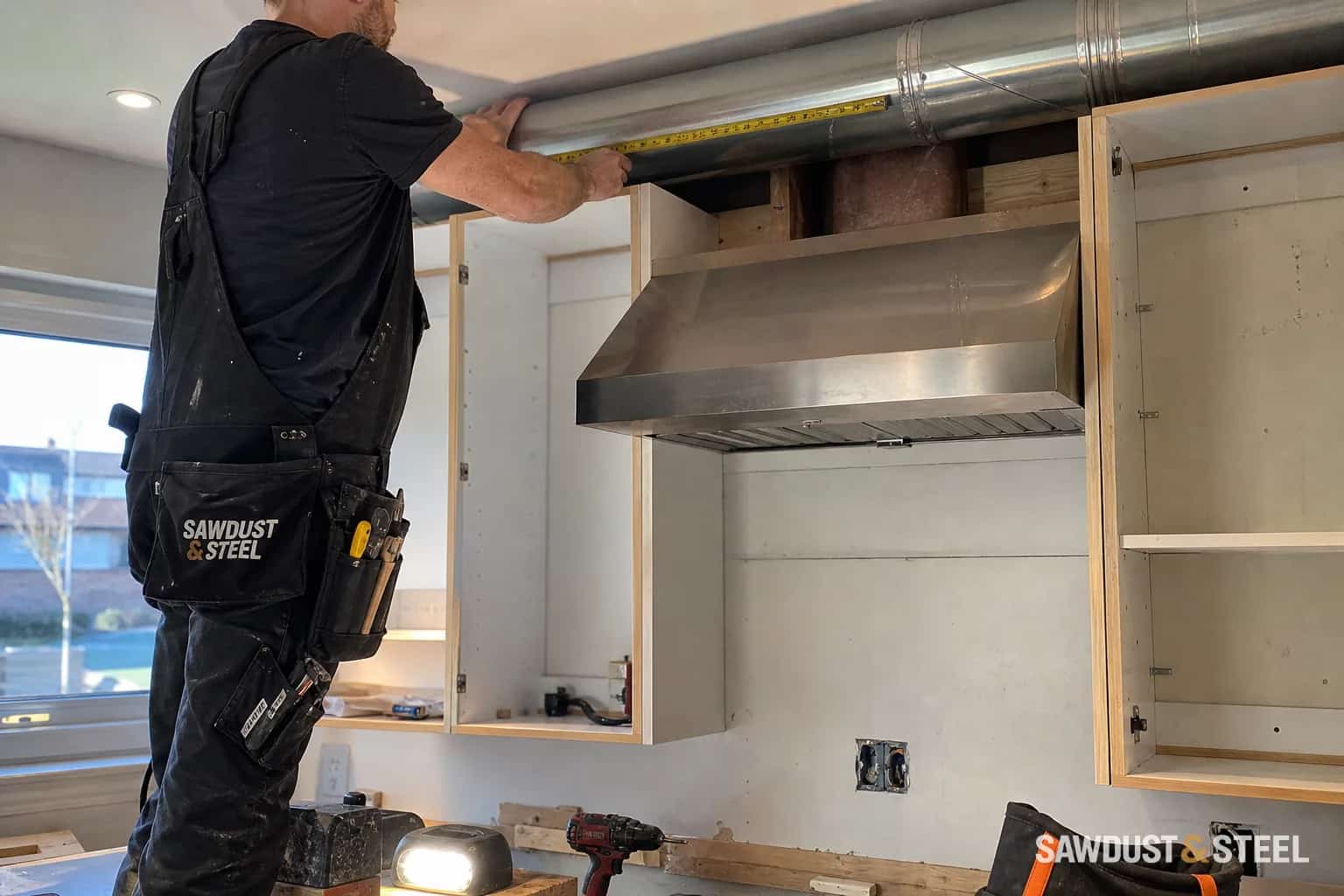
A range hood can look impressive and still leave the smell of dinner in the hallway. Plan it while the cabinets and duct route can still change. The hood needs to catch grease, moisture, particles, odours, and any gas-cooking pollutants near the stove. It also needs a way for fresh air to replace the air sent outdoors.
What should be decided before the cabinets?
| Question | Decision | Why it matters |
|---|---|---|
| What will be cooked? | Appliance fuel, width, output, and actual cooking habits | Frequent frying or searing creates a different load from gentle simmering |
| Will the hood capture the plume? | Canopy width, depth, mounting height, and wall or island position | Air that misses the canopy is already in the kitchen |
| Where can the duct go? | Model-specified diameter, equivalent length, elbows, and exterior termination | Resistance reduces delivered airflow and raises noise |
| How will air be replaced? | House airtightness, other exhaust devices, fireplaces, and fuel appliances | The answer affects comfort, pressure, and combustion safety |
| Which approvals apply? | Building, electrical, mechanical, and fuel scope | Exterior openings and controls are cheaper to resolve before cabinetry |
How should range-hood size be chosen?
We first mark the canopy's outline above the actual cooking surface, including its front edge. On a hood replacement, the owner's largest frying pan sat on the front burner, beyond much of the old hood's reach. Simply buying a stronger motor would have left that geometry unchanged. The new canopy choice had to suit the cooking pattern as well as the duct. Island positions also face air moving across the room; a downdraft has to pull hot cooking air down when it naturally rises.
Health Canada recommends a hood that fully covers the burners and vents outdoors when possible. Its cooking and indoor-air factsheet reports substantial pollutant reduction from effective hood use in the studies it cites. Use that as a reason to capture well, not as proof that one advertised CFM fits every appliance and duct route. Follow the selected hood and cooking-appliance instructions.
How should the exhaust duct be built?
Use smooth, corrosion-resistant metal duct in the size required by the hood manufacturer. Keep the run short, limit fittings, count equivalent length, and terminate directly outdoors through an approved wall or roof cap with a working damper. Do not reduce a larger outlet into an old dryer-style duct or discharge grease and moisture into an attic, wall, garage, or soffit. Broan-NuTone's duct guidance makes the same basic point: smooth, correctly sized, and direct wins.
The exterior location must also respect the approved clearances from openings and air intakes. A local inspection checklist may state a minimum duct size, but the selected hood can require more. Code minimum is not permission to ignore the installation manual.
When does makeup air need professional design?
Makeup air is outdoor air deliberately supplied to replace exhaust. The familiar 400 CFM threshold comes from U.S. model-code and manufacturer guidance; it is not a universal Ontario switch. Health Canada's ventilation guide notes that larger exhaust fans, roughly 200 to 400 CFM and above depending on the house, can require added makeup air. The real review considers delivered airflow, house leakage, dryer and bath fans, central vacuum, fireplaces, and fuel-burning appliances together.
Professional review matters when negative pressure could reverse a chimney or gas vent. A permanent solution may use a passive inlet, motorized damper, dedicated supply fan, tempering, or a coordinated mechanical design. An open window is a temporary measure, not a substitute for required mechanical design. An HRV or ERV is not automatically large enough or approved to serve as range-hood makeup air.
What changed for some natural-draft boilers in 2026?
TSSA's current FS-279-26 amendment adds a heating-season safety-check duty for a specific group: qualifying natural-draft boilers with draft-control devices in one- or two-family homes, within the document's stated 300,000 Btu/h threshold. From October 15 through April 30, when a certified G1, G2, G3, or GUT technician attends that home for service, maintenance, or emergency work within the certificate scope, the technician must check for the qualifying boiler and follow the prescribed safety steps unless a valid inspection label is already present.
Those steps include flue-gas carbon-monoxide measurement and visual checks; signs of spillage can trigger a depressurization test and corrective action such as adequate combustion and makeup air. This is not a rule that every boiler receives a separate government inspection, and it is not triggered by every kitchen renovation. It is a technician obligation tied to the stated boiler type, home, attendance, and season. A range hood near any natural-draft appliance still deserves careful pressure review whether or not that narrow check applies.
What should installation and commissioning verify?
Before cabinet drawings are final, confirm the appliance, canopy, duct route, replacement-air strategy, exterior locations, and approvals. The Electrical Safety Authority says most changes to original wiring require notification and hired residential electrical work must go through a Licensed Electrical Contractor. Fuel work belongs with a TSSA-registered contractor and appropriately certified technician.
After installation, verify exterior discharge, damper and interlock operation, usable capture at the cooktop, and safe operation of combustion equipment under relevant exhaust conditions. Use the hood whenever cooking, including with induction, and clean its filters as directed. Dirty filters can reduce airflow even when the fan sounds normal.
If the range is gas, continue with the Ontario gas-stove venting guide. For the room sequence, see the GTA kitchen-renovation timeline or our kitchen renovation service.
Before the cabinet maker fixes that last dimension, check how high the hood should sit above your cooking surface. It needs to catch what comes off the pan and still let you lift the stockpot lid. That is worth trying before the tile goes on.