
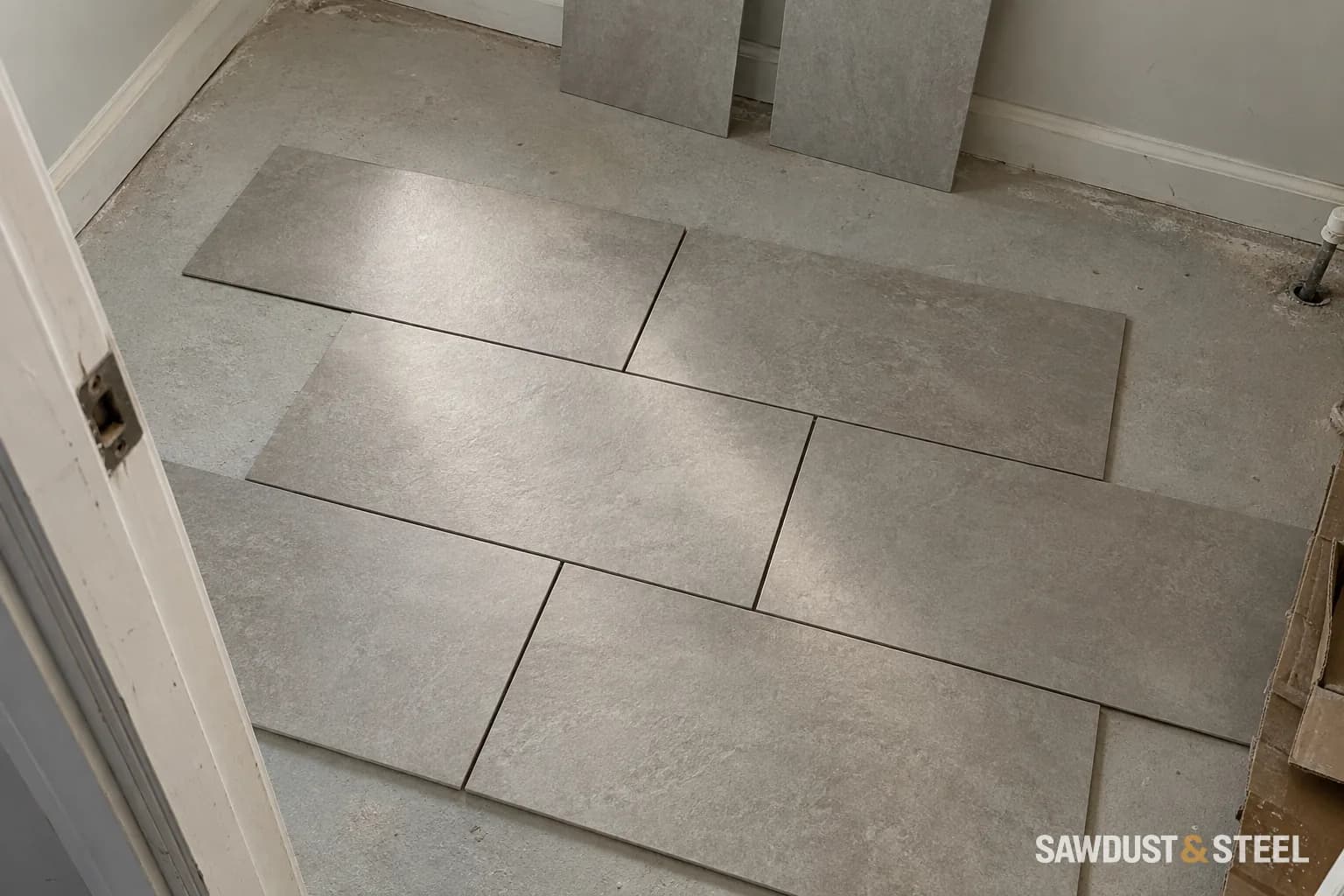
In a tile shop visit, Ada chooses the biggest sample because she hates cleaning grout. At home, the proposed layout leaves a skinny cut beside the doorway and an awkward notch around the toilet. She has reduced the number of lines, but made the remaining ones impossible to ignore.
Start at the doorway, not the centre of the sample
Ask the installer to draw the tile grid over the measured room, including finished wall thicknesses, the vanity, toilet, threshold, and shower. Compare at least two starting positions. Centre lines are useful, but a mathematically centred grid is not always the best-looking arrangement at the entrance. On Ada's plan, shifting the starting line moved the worst sliver under the vanity, but made the threshold cut awkward. We drew that option too rather than pretending there was a layout with no compromises. Comparing the two full-room grids made the eventual smaller floor tile an easier choice.
Include the movement-joint detail at the doorway in that drawing. An edge trim and a movement joint can have different jobs.
- Check the size of the visible perimeter cuts before placing the order.
- Look at the pattern across several tiles, including repeated printed faces.
- Confirm the manufacturer's permitted offset, grout-joint width, and installation method.
- Include preparation and difficult cuts in the quote rather than assuming fewer tiles mean less labour.
Flat and level are different questions
Large tiles can expose humps and dips that a small sample conceals. The installer needs to assess substrate flatness and the required preparation before setting tile. A floor can slope as a whole yet be flat; a level reading at one spot does not prove the entire surface is ready. Levelling clips do not replace appropriate substrate preparation.
For long rectangular tiles, discuss the offset pattern and potential lippage using the actual product. A sample layout can reveal an edge-height issue before the whole floor is installed.
The shower is its own tile decision
A shower floor must work with its drain and slopes. Smaller formats can follow multiple planes more readily; a linear-drain design may allow a different layout. Daltile's tile-selection guidance distinguishes approved applications, including shower floors. Check the exact product rather than assuming a bathroom-looking tile is suitable everywhere.
Ada's compromise keeps large tiles on the walls and uses a smaller floor format. There are more grout lines than she wanted. There is also no tiny triangle of tile greeting her every morning. She decides that is a tolerable negotiation.
Still choosing where the bottles will go? Niche placement can change the wall layout you just approved. Settle that with the shower corner joints, then use the bathroom sequence to put those decisions ahead of wall closure.