
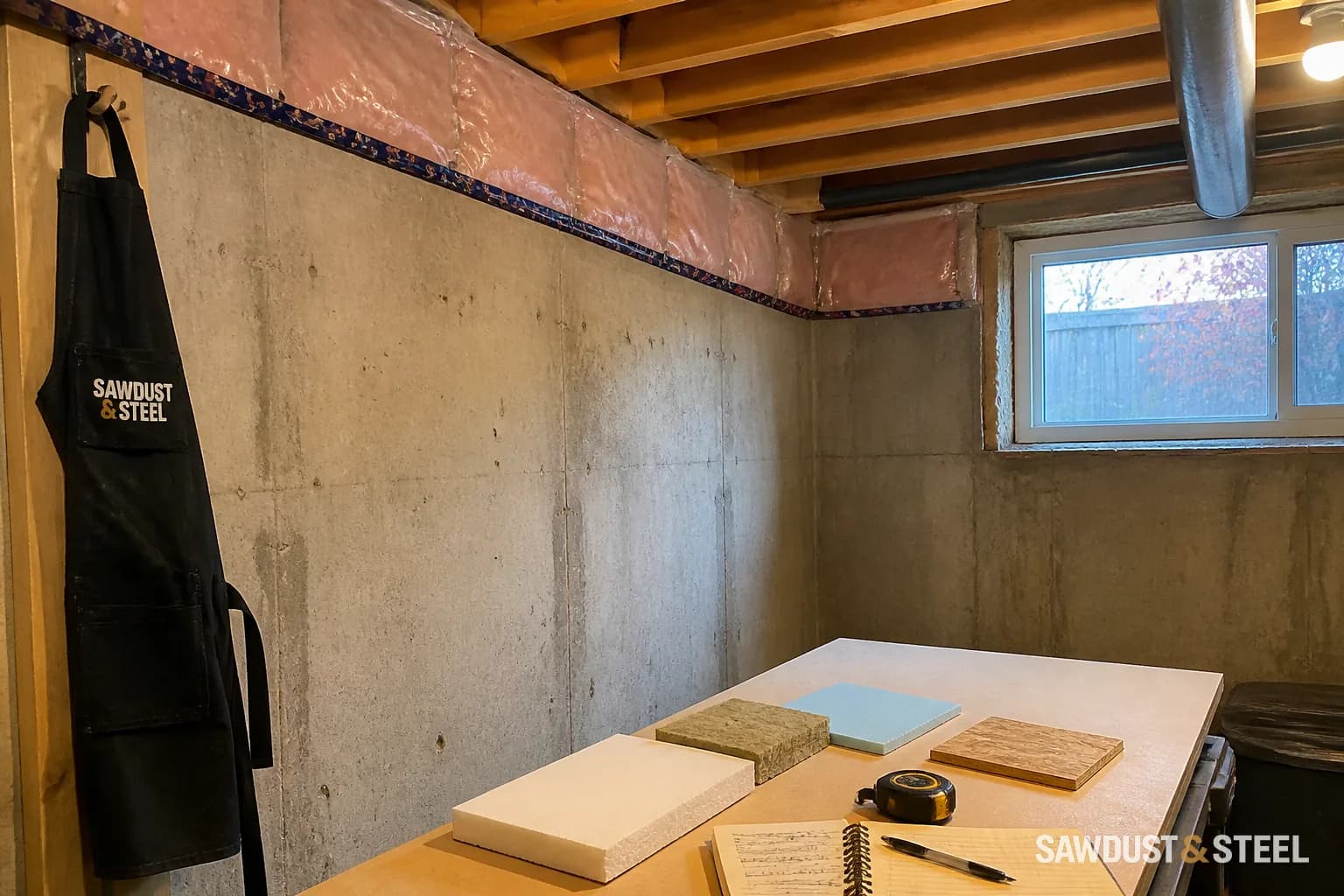
Nobody wants to pay for basement insulation twice: once before the drywall goes up and again after a damp corner gives the game away. Before comparing R-values, check the foundation, moisture and the junctions where the new wall meets the floor above. Your permit drawings need to explain how those layers work together. The number on the insulation package is only one part of the answer.
What does Ontario code actually require?
Ontario's current Building Code governs construction, while the applicable energy-efficiency route may use Supplementary Standard SB-12. The required insulation level and details can vary with the building, climate zone, assembly, renovation scope, and compliance option. The approved permit drawings and your municipal building department are the project-specific answer.
The easy part is drawing a tidy section through the middle of a blank wall. On site, we have a water service, a ledge, a rim joist and three trades asking where their work goes. In a basement laundry conversion, the chosen insulation detail worked along the straight wall but had no clear transition around an old pipe entry. We held that corner open, got the designer's junction detail and completed it before boarding. Otherwise, the best-looking part of the insulation would have hidden the part we had not solved. Indoor air reaching cold concrete can cause moisture trouble even when the product has a high R-value.
Which basement condition changes the insulation plan?
| What you find | Why it matters | Next move |
|---|---|---|
| Active water, dampness, or efflorescence | Finishes can hide a drainage or foundation problem | Find and correct the source first |
| Dry foundation with an interior renovation | An interior assembly may be practical | Have the designer detail every layer |
| Exterior excavation already planned | Exterior insulation and water control may be coordinated | Design both scopes together |
| Future bedroom, office, or family room | The basement becomes normally occupied | Test radon and confirm permit requirements |
Should I fix moisture before insulating?
Yes. Natural Resources Canada's basement insulation guidance starts with checking moisture, drainage, cracks, and structural conditions. Insulation slows heat flow; it is not a waterproofing system. If the wall becomes wet after rain, start with our basement waterproofing guide.
Should basement insulation go inside or outside?
Exterior insulation can keep the foundation warmer and can pair well with exterior water-control work, but it requires excavation and careful protection. Interior insulation is common in renovations because it is accessible, but the layers must control air leakage and moisture without trapping water against vulnerable materials. Neither location is automatically right for every existing foundation.
Do not choose the assembly by insulation type alone. Ask how it handles rim joists, ledges, stone or block walls, below-grade wood, electrical boxes, plumbing, fire blocking, and transitions to the slab and above-grade wall. Ask to see the junction details as well as a typical wall section. If your plan includes an unheated cold cellar, work through the cold-cellar conversion choices before extending the finished basement into it.
What must stay visible for inspection?
Your permit will identify required inspections. Insulation, air-barrier details, framing, and service rough-ins commonly need review before drywall covers them. Confirm the sequence with the municipal inspector and read our Ontario renovation inspection guide. A photo record is useful, but it does not replace an inspection that was required while the work was open.
What should I do today?
- Photograph every basement wall after rain and note damp areas, staining, cracks, and odours.
- Decide how each finished room will be used and confirm whether the scope needs a permit.
- Start a long-term radon test in the lowest area that will be regularly occupied.
- Ask the designer to put the full wall, rim-joist, and slab-edge details on the drawings.
- Confirm the inspection sequence before ordering drywall.
Seal the rim or header joist before the ceiling closes
The rim or header area is the perimeter where the floor framing meets the exterior wall above the foundation. NRCan's basement insulation guide treats it as a separate junction. Inspect for dampness, deteriorated wood and service penetrations while it is visible. Insulation stuffed into a gap does not by itself establish a continuous air barrier.
Top: rim and subfloor
Show how the wall air-control layer connects around framing and penetrations.
Middle: foundation wall
Specify the complete moisture, insulation and finish assembly for this foundation.
Bottom: wall and slab edge
Show the connection at the slab, including planned radon or water-control details.
Junction checklist only; it does not prescribe a universal order of insulation and vapour-control layers.
Ask the installer to point to the continuous air-control line with a finger around the perimeter. Pipes, cables, ledges and joists should each have a resolved transition. Confirm sealant and membrane compatibility, insulation protection and required clearances at equipment; do not foam indiscriminately around hot flues or components needing service.
| Before concealment | Record |
|---|---|
| Condition | Dryness and repairs at the perimeter |
| Transitions | Close photos and a wider photo identifying the wall |
| Services | Access to valves, dampers and other maintained components |
| Protection | Specified covering and fire-blocking details |
| Review | Required inspection result before soffit or drywall installation |
Photograph each completed bay with a location label and fixed reference. Keep the awkward corner behind the pipe on the list even if the straight wall looks finished. Rotted sill-plate investigation comes before covering damage; HRV balancing addresses the separate ventilation question when the enclosure changes.