
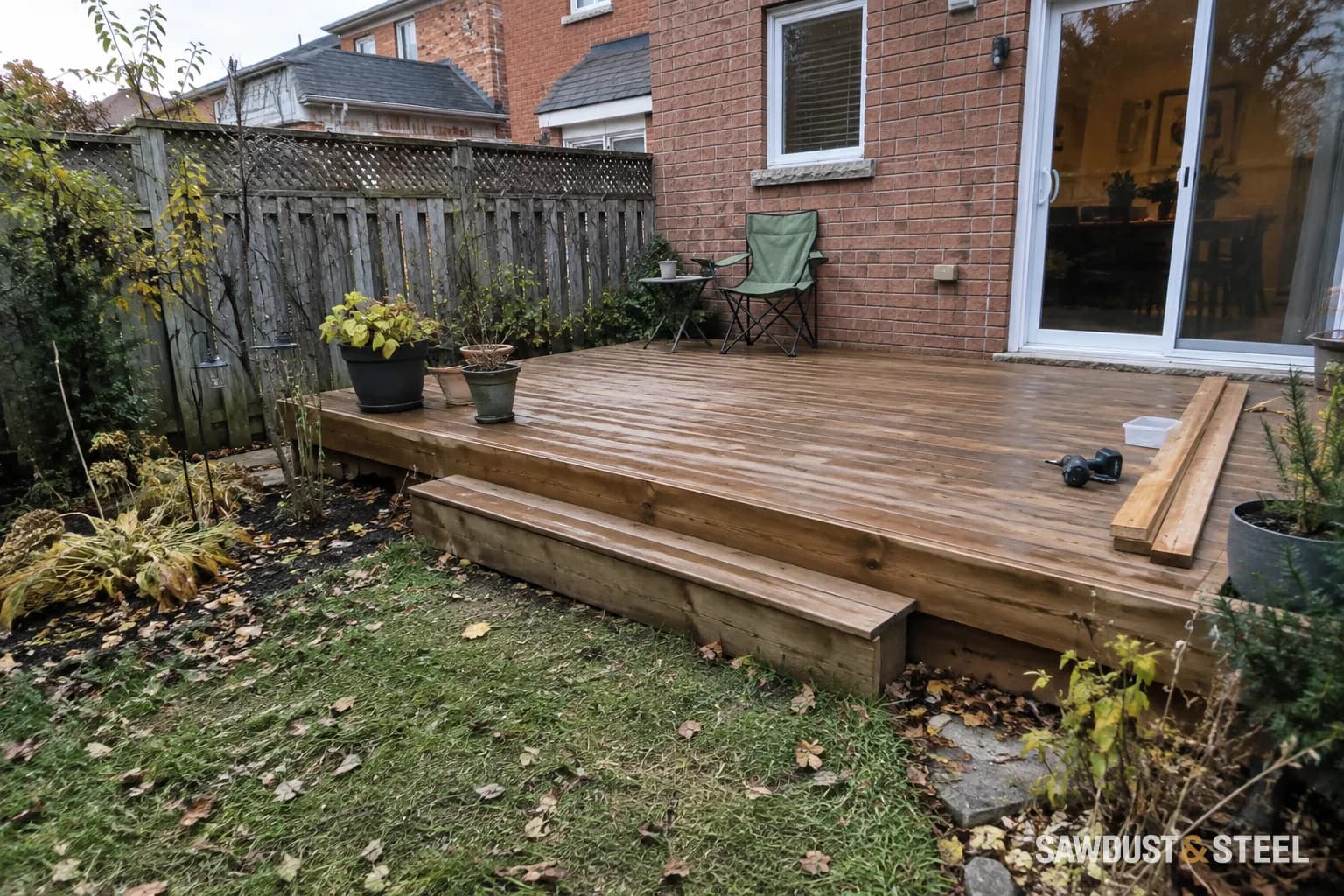
In this backyard, Marcus has already chosen composite boards. The old frame looks sturdy from the lawn. Once a few boards come off, the area near the house looks less convincing. His weekend refresh now needs a proper decision instead of a bigger shopping cart.
Separate worn decking from a worn structure
Trex's resurfacing guidance starts with a sound foundation and framing system. That condition matters more than the promise of a quick makeover. Have the exposed structure assessed before ordering the entire walking surface, especially where the underside was previously hidden.
- Inspect joists, beams, posts, footings, and accessible connections for deterioration or movement.
- Check the ledger and flashing where the deck meets the house.
- Compare joist spacing and board direction with the new decking manufacturer's requirements.
- Include guards, stairs, blocking, fasteners, and board-end support in the review.
| Finding | Next decision | Evidence to retain |
|---|---|---|
| Sound framing and suitable board support | Resurface after complete compatibility review | Exposed joist tops, ledger and connections photographed |
| Local deterioration with otherwise suitable structure | Define a repair before pricing retained framing | Close-up plus wider photo showing the affected member and bearing |
| Widespread decay, movement or unsuitable layout | Compare a rebuild without forcing new work around weak old parts | Structural assessment and proposed replacement arrangement |
| Old footings of unknown size or depth | Investigate before agreeing reuse | Dimensions, locations, condition and load assessment |
Take photos after removal and again after repairs, before tape or boards conceal the work. Include the whole member as well as close-ups: a dark spot without its location is not much of a record. Joist tops, ends at the ledger, post connections and stair support deserve their own views. Do not crawl under an unstable frame to collect them.
Composite is not a straight swap for every wood board
Different board profiles, installation angles, and stair applications can require different support spacing. The new board thickness can also affect step heights and door transitions. Ask the builder to show the complete system, not just price by deck area. Trex's resurfacing walkthrough specifically directs installers to check spacing and applicable local requirements.
Check composite deck joist spacing for the exact board and laying angle, then check stair-stringer spacing separately. A frame suitable for the deck surface can still leave composite stair treads without the support their manufacturer requires.
When replacement work involves pressure-treated lumber, include the required treatment of fresh cuts and holes before the new decking hides them.
Price the discovery point
A useful quote separates board removal, assessment, agreed structural repairs, and the replacement surface. Ask what happens if concealed damage is found. Agree when work pauses for an updated scope, and confirm local permit requirements for the actual alterations. An old deck's existence does not establish approval for a new configuration. If only a few boards are distorted, compare cupping, flipping and selective replacement before pricing every board. Raised fastener heads call for their own fastening-condition check.
Marcus's project keeps most of the frame, but opening the house edge adds a connection repair to the scope. We also check the new board thickness against the top step before fastening a whole run. The new surface needs the support and stair detail agreed for that product, even where the old boards seemed fine. He postpones the decorative border to keep the repair in budget. We photograph the exposed repairs before the surface goes on, so he knows what the saving actually retained.
If the house-side boards are the worst ones, the ledger flashing guide is the next useful read. If the exposed frame is sound, find out where joist tape earns its place before covering it. And once the repair scope is clear, check the deck permit rules against the work you're actually doing.
Describe removal and replacement together
Oakville's application guidance includes demolition as well as construction. Ask Building Services what approvals apply to your specific removal and rebuild. Do not assume a permit for the new deck automatically answers every question about dismantling the old one.
Show whether the size, height, stairs, or attachment will change. Calling it a "replacement" does not make a larger or differently supported structure the same project.
Decide what happens to the house
- How the elevated door will be secured while the deck is absent.
- Whether another safe household exit and garden route remain available.
- Who will weatherproof the wall after the old ledger is removed.
- How exposed damage will be documented and priced before rebuilding.
- Where dismantled material can be carried and collected without blocking access.
On a rebuild, removing the old ledger exposed a strip of damaged wall that the deck had hidden. We photographed it, agreed the repair, and made the opening weatherproof before the next rain. The new framing waited. That pause was less disruptive because the quote already named who handled concealed wall damage and how changes were approved; nobody had to invent the process with rain in the forecast.
Existing footings need evidence
A footing that has stood beneath the old deck is not automatically suitable for a new layout. Its location, condition, dimensions, bearing, and proposed loads all matter. Concealed information may need investigation before reuse can be agreed.
Simpson Strong-Tie's deck guide separates retrofit from replacement and highlights the connections beneath the surface. Use that distinction to ask what is being assessed, rather than accepting "the posts look fine" as the entire reuse plan.
Keep the first scope honest
Ask the quote to distinguish removal, disposal, wall repairs, retained supports, and new construction. Walk the carry route too: a narrow side gate may mean cutting and carrying material in smaller pieces, while the new lumber needs its own delivery route. If hidden conditions prevent a fixed repair price, agree how findings and changes will be approved. Keep the door barrier in place until the replacement access is ready.
The best catch to discover early is that keeping one old component would force the whole new deck into an awkward shape. Sometimes starting again buys a better doorway, a simpler stair, and fewer inherited compromises.
Before changing the footprint, check deck setbacks using the legal property boundary, not the location of the old frame.